Chapter 2: The Relationship And The Rupture
The relationship with Shell did not begin badly. That is why the rupture hurt as much as it did.
If Shell had always behaved like an enemy, the story would be simpler. I could place the company in the usual category of corporate giant, shrug, and say we had never been foolish enough to trust them in the first place. But that is not true. The reason the break felt like betrayal rather than bad luck is that, for a long time, Shell had been an excellent client. We did good work for them. They did good business with us. There was trust, and not merely the ceremonial kind that appears in polite correspondence and disappears at the first sign of trouble. There was working trust, commercial trust, the kind that grows when people repeatedly rely on one another and profit from doing so.
The direct relationship began in June 1981 after a presentation at Shell-Mex House in London. To a businessman in my line of work, that mattered. Shell was one of the biggest names in the world. A contract with them was not just another piece of paper; it was a sign that one had arrived somewhere serious. Over the years that followed, we created and supplied a succession of promotions for Shell. Some were large enough to make real noise in the petrol market. Some were imaginative enough to travel. Some were successful enough to make both sides feel they had found an arrangement worth preserving.
By the time Shell Make Money came along, the relationship felt mature. We were not outsiders peering in hopefully through the glass. We were trusted promotional consultants with a record. Shell Make Money did not merely tick along respectably. It took off. It caught motorists' attention. It won an Institute of Sales Promotion award. It helped cement the feeling that our partnership with Shell was both commercially potent and, for want of a better phrase, a proper thing. Shell succeeded. We succeeded. That is how good business ought to work.
For about a decade, it did.
That is the period some future reader might be tempted to hurry through on the way to the fireworks, but it must not be hurried. The emotional logic of everything that follows depends on it. I was not some serial litigant haunting Shell from the edges. I was a businessman whose company had helped Shell make money and attract attention. We had built something of value together. I had every reason to assume the relationship, whatever its ups and downs, rested on recognisable standards of decency and confidence.
Then Shell appointed a new national promotions manager, whom I will call AJL.
There are points in life where one only later realises a change in personnel was the beginning of a wholly different story. At the time, the appointment did not arrive with dramatic music. Companies change managers all the time. Titles shift. New faces appear. Structures alter. Business carries on. But from where I stood, this was the start of the wobble. The old stability went out of the relationship.
As I later came to believe, AJL had a personal relationship with a company called Option One, which in my view began benefiting in extraordinary fashion from Shell promotion contracts. On one occasion, as I saw it, they effectively won a race in which they had not even run. It was like watching a horse collect the prize after failing to appear on the course. That sort of thing does not merely annoy a businessman. It corrodes the whole atmosphere around a client relationship. It makes one wonder whether the game is still being played honestly.
The decisive shock came one morning with a newspaper.
I was at home, seated at my desk, on my own, when I opened the Daily Mail and saw an advertisement for a Shell promotion based on a Nintendo Game Boy theme. What made it shocking was not simply that Shell was running a promotion. Shell did that all the time. What shocked me was that the promotion appeared to be based on an idea I had presented to AJL in the strictest confidence and discussed with David Patton at Nintendo. I was astonished and shocked. Then I was furious. I knew at once that something was badly wrong.
I telephoned him immediately.
In that call I raised the obvious concern: how had Shell come to be advertising a promotion that seemed rooted in an idea I had entrusted to him confidentially? I was controlled, but angry, and I think that was obvious to him. I also told him I could send written proof that we had entered into a contract with Shell in respect of Make Money. His response, as I remember it, was effectively that he did not care about being sent anything in writing and was sure Shell could run the promotion without us anyway. During the same discussion, AJL said something I have never forgotten: Shell could run Make Money without us.
That sentence has stayed with me because it contained, in embryo, the whole future. It was blunt, dismissive and revealing all at once. It suggested not merely disagreement over one idea but a deeper corporate assumption: that Shell could take the essence of what we had built together, detach it from us, and carry on regardless. In one line, a decade of mutual success began to curdle into something else. I felt anger, disbelief, betrayal, determination and, mixed in with all of it, sadness. AJL already seemed utterly unlike the people at Shell with whom we had worked successfully for ten years. Even then I had the sense that the relationship was likely to end badly.
Before long a Shell insider friend told me that a Make Money game was under production in North Wales by Dobson and Crowther, a printer that had produced Shell games for us before. That discovery mattered because it turned suspicion into something harder and uglier. One can survive misunderstandings, delays, bruised egos and clumsy conversations. Business is full of those. But the sense that a trusted client has crossed the line from hard dealing into misuse of confidence is different. It strikes not only at profit but at dignity. It tells you that the years you spent building trust may have been, from the other side's point of view, no more than a useful prelude to appropriation.
We did not rush to court simply because we were angry. We tried to be reasonable. As I remember it, we proposed an attempt at mediation and suggested a former Shell manager, John Smedal, as mediator, which he did. Then Shell kept us waiting for its final position until after the Shell Make Money promotion had finished its run. Only days after that, as I recall it, they said there would be no offer to settle. That was when we issued the High Court writ over Make Money. It mattered to me then, and it matters to me now, that we had tried the sensible route first.
What upset me especially was that the quarrel did not stop at one promotion. At one point Shell advanced a claim that it had devised the Star Trek-themed game. I knew that to be false. I had organised that idea in principle with Paramount Pictures, with the licensing agreed, subject to a presentation to Shell. Shell knew nothing of it until I disclosed it. When I later saw Shell claiming otherwise, my reaction was rage and disbelief. It is hard to explain to anyone who has not built things for a living how offensive that felt. This was not merely a disagreement about money or contract wording. It was a drift toward rewriting authorship itself. I was fortunate that there was published material pointing to my role, because by then I had already learned not to assume the truth would simply take care of itself.
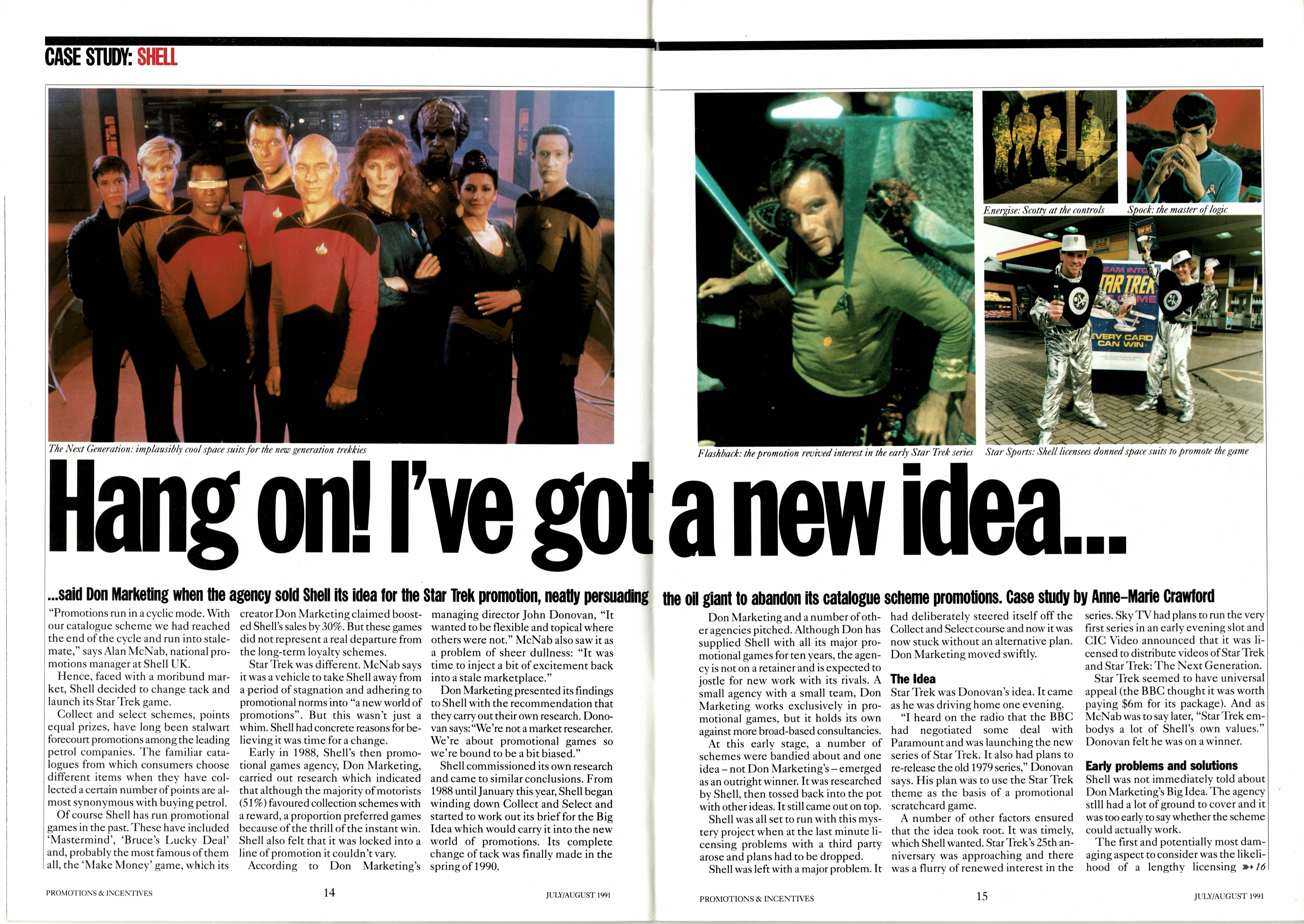
Promotions & Incentives article on the Shell Star Trek promotion, reproduced as evidence of Don Marketing's public connection with the game.
This was the point at which my relationship with Shell ceased to be merely commercial. It became moral.
That distinction matters. Companies are accustomed to price disputes, contractual arguments and ordinary trade resentment. They are less comfortable when the other side insists that the issue is not only money but conduct. From my point of view, that was the issue. We had given Shell ideas, labour, loyalty and success. We had done so under conditions that assumed confidence meant confidence. If Shell or Shell personnel chose to use confidential material as if it were simply lying about ready for the taking, then the injury was larger than a lost piece of business. It was a corruption of the relationship itself.
That corruption did not arrive cleanly labelled. There was no moment at which Shell said, "We are now the villain of your life story." Real life is cruder than that. There were telephone calls, documents, discoveries, denials, assertions, and eventually lawyers. Over the years there would be repeated High Court actions, libel claims, a county court action, Shell counterclaims, settlements, pressure, expense, and repeated attempts by Shell to frame matters differently from the way I understood them. But the emotional truth of it was already present in that earlier moment of shock: the newspaper advert, the telephone call, and the cold implication that Shell could take what it wanted and leave us to protest from the side-lines.
Looking back, I think this is why the dispute never felt to me like a technical quarrel. A technical quarrel can be settled, pocketed and forgotten. This felt like breach of faith. It felt like a large organisation deciding that the rules were more flexible when applied to itself than when applied to a smaller business. It felt like discovering that the word "relationship" meant one thing to us and something far more disposable to them.
For a while, no doubt, Shell assumed that whatever grievance existed could be managed as large companies manage such matters: with letters, lawyers, denials, delay and the sheer advantage of scale. In that sense the company's calculation was understandable, if ugly. Big organisations rely on the fact that smaller opponents tire sooner, spend out sooner, lose heart sooner, and eventually make peace with injustice because the alternative is exhausting.
What Shell may not have seen then was that by breaking trust in the way I believed they had, they were not merely creating a claim. They were creating a witness. They were creating an adversary with memory. They were creating the later man with the archive, the websites, the source files, the documents, the persistence, and eventually even the AI bots. The long war began not with some grand ideological collision but with a breach inside what had once been a happy and highly successful commercial relationship.
So I still use the word betrayal. It is not melodrama. It is the right word.
Shell had been our best client. That was what made the break so devastating.
The legal machine comes next. But before we arrive in the courts, the essential wound is already visible: trust given, trust used, trust broken.