Author's Note
This book is based on my own experience and on a large documentary record built over many years: correspondence, court papers, company documents, archived websites, press coverage and later research.
Where a point rests on a document, I have tried to make that clear. Where a point remains disputed, or reflects my recollection or interpretation, I have tried to make that clear too. This is narrative nonfiction, not a legal pleading, and it is written in the belief that the human cost of a long corporate dispute should not disappear inside the paperwork.
Dates are given as precisely as the record allows. Some names, quotations and allegations appear in the form in which they entered the documentary trail; others are presented more cautiously where proof is incomplete or the matter remains contested.
Prologue
There is something faintly ridiculous about the way my dispute with Shell has entered old age.
I sit at a keyboard and ask machines questions about a company that has dominated far too much of my life. I ask ChatGPT. I ask Copilot. I ask Grok. I ask Perplexity. I ask whatever new oracle Silicon Valley has produced this week. I give each of them the same material, or nearly the same material, and watch them squirm, contradict themselves, regurgitate old reporting, rediscover buried facts, miss obvious points, and occasionally blurt out something rather close to the truth.
At one level it is comic. A fight that began in the world of petrol promotions, paper files, telephone calls and boardroom courtesies now plays out through artificial intelligence. At another level it is not comic at all. These systems are being trained on the electronic afterlife of forty years of documents, articles, leaks, correspondence, court papers, accusations, apologies, and unfinished business. They are not solving anything. They are exposing the fact that the story still exists, still has force, and still refuses to stay buried.
I did not set out to become the curator of a digital battleground. I certainly did not set out to become, in my late seventies, a one-man media machine feeding Shell's history into competing bots. That would have sounded absurd to the younger man I once was, a man who liked making things, winning contracts, coming up with ideas, seeing them take shape in the world. The version of me now sitting at a keyboard asking questions of machines is not the man I expected to become. He is the man Shell helped to make.
The modern phrase for what I am doing might be "information warfare," though I confess I prefer less fashionable language. What I am really doing is continuing. That is the central fact. I am continuing because the matter was never put right. I am continuing because what ought to have ended decades ago did not end. I am continuing because Shell, despite all its size, wealth, codes of conduct, public slogans and business principles, has never done the one thing that might have allowed me to put down the file at last: negotiate seriously, apologise properly, and make fair redress.
I make the point bluntly because I do not want this book mistaken for the work of a man in love with grievance. I am not. Anyone who imagines that I have spent four decades in blissful enjoyment of litigation, threats, sleeplessness, documents, websites, leaks, and endless argument understands nothing at all. The truth is much simpler and sadder. I wanted a good life. I had earned one. I had one, or the beginning of one. Then I found myself dragged into a long struggle with one of the largest companies in the world. The legal routes that were supposed to produce justice did not do so. The so-called peace that followed did not hold. The years went by. The archive grew. My anger hardened into discipline. My private dispute became public record.
Somewhere along the way, I became useful to other people with grievances against Shell. Some saw me as a crank. Some saw me as a nuisance. Some saw me, rather flatteringly, as a whistleblower. Journalists called. Insiders sent material. Shell watched. Shell worried. Shell denied. Shell postured. Shell occasionally blundered. I kept going. Not because it was healthy. Not because it was noble every day. Not because I had discovered a secret taste for permanent war. I kept going because I could not persuade myself that the alternative, which was to shrug and let a giant corporation stroll away from what had happened, was something I could live with.
That has cost me dearly. It has cost money, time, energy, peace of mind and opportunities that do not come back. It has shaped family life. It has narrowed life in ways that are hard to calculate. The bill for a long campaign is not just legal. It is existential. It changes who you are. It changes what others expect you to be. It changes how a room feels when your name is mentioned. It even changes the rhythm of old age. Other men in their late seventies may take up golf, gardening, or a more sensible relationship with the daily news. I compare chatbot answers about Shell.
But if the present is strange, the beginning was ordinary in a far better way. The beginning was not a crusade. It was business. It was ambition. It was creativity. It was my father and me making ideas that worked. It was the pleasure of being good at something. It was meeting serious people from serious companies and finding that they took us seriously too. There was a time when Shell was not my adversary. It was my best client. There was a time when the name Shell brought to mind scale, prestige, a famous jingle sung by Bing Crosby, and the satisfaction of dealing with one of the biggest brands in the world.
That is why the story must begin there, before the websites, before the leaks, before the spies, before the judges, before the chatbots and the bot war and all the strange electronic machinery of this late chapter. To understand why I kept going, you have to understand what existed before the fight. To understand the fury, you have to understand the trust. To understand the old man at the keyboard, you have to understand the younger man who thought he was building a life.
Before Shell became a fate, it was a client.
Before I became a campaigner, I was a businessman.
Before I built an archive, I built promotions.
And before I spent years learning how power behaves when challenged, I had the simpler and happier experience of success.
Chapter 1: Before Shell Became A Fate
There was a time when Shell was not the organising fact of my life.
That sentence may sound obvious, but after all these years it needs saying plainly. Anyone discovering me through my websites, through leaked documents, through articles about Shell's critics, spies, scandals, or now through the curious modern theatre of AI bots arguing over my archive, might reasonably imagine that I was born mid-dispute. It can look as though I arrived in the world already carrying a bundle of papers and an instinctive mistrust of multinational oil companies. That is not so. I had a life before Shell became a campaign, and it was not a bad one.

My father and I had done well. We had lived in a succession of handsome houses. In Devon I owned a six-acre plot of land where my father and I obtained planning permission to build a 160-room motel. In Essex we had garage businesses. One of them held a Standard-Triumph and Chrysler new-car franchise. We sold the land. We sold the garages. In 1979, the year I sold the last garage business, I founded Don Marketing with my father, his brother, and a chartered accountant, Don Redhead.
That background mattered more than it may first appear. I had not wandered into promotions from nowhere. I knew the motor trade from the practical side, the customer side, the forecourt side. When later we created promotions for petrol companies, we were not guessing at the rhythms of that world from an office tower. We understood how ordinary motorists behaved because we had been around that trade in real life.
It was a good decision. More than that, it was an exciting one. We turned out to be a formidable team. We were imaginative, energetic, and rather better than many people first assumed. That last point matters. Britain has always had a way of underestimating creative commercial people unless they arrive with the right accent, the right school tie, or the right inherited address. We did not wait for anyone's blessing. We produced the goods.
What we produced were promotional games, but that phrase can make the work sound smaller than it was. Done badly, promotional games are forgettable gimmicks. Done properly, they alter markets. They create excitement, public attention, footfall, loyalty and talk. They can make an ordinary purchase feel like an event. We became extremely good at that. We made innovative games for packaged products such as Shredded Wheat. We worked for alcohol brands including Guinness. Our advertisements, with a confidence I still think was justified, described us as world leaders in promotional games.
That was not mere bluster. Our ideas travelled. They travelled because they worked and because people at the highest level could see they worked. NBC and CBS in the United States did not take an interest in us out of charity. NBC sent a team to London, led by senior vice-president Steve Sohmer, to inspect us before signing a contract for a unique promotional concept that had already obtained approval from the American authorities. I still have documents from that period. The contract was signed by me and by Ray Timothy, the president of NBC Television. It is one thing to think you have built something impressive. It is another thing to watch major American broadcasters conclude the same thing.
CBS was equally serious. James Rosenfield, president of the CBS Television Network, invited me to breakfast in his office. It was served by a uniformed butler, which is not the sort of detail one forgets. The invitation said something about the regard in which our ideas were held. So did the interest from other companies. When we approached Tesco with a proposal, the managing director met us at the Savoy Hotel in London to discuss it over lunch. Those are not the arrangements companies make for mediocrity.
There was, in those days, momentum in my life. Not just financial momentum, though that mattered. There was the feeling that one was moving forward in the world under one's own steam. Ideas led to meetings. Meetings led to contracts. Contracts led to more work, better work, larger ambitions. A successful business creates not only income but atmosphere. It changes what seems possible. It teaches you to think ahead. It allows you to picture a pleasant future with some confidence.
Then there was Shell.
I had known the name, of course, as everyone did. It belonged to that class of brands so large they seem less like companies than weather systems. To me it carried a little extra charm because I associated it with the Bing Crosby jingle. More importantly, it was one of the biggest brands in the world. To do business with Shell was to feel that you had entered the premier league. When Shell became our client, it was not just welcome business. It was validation.
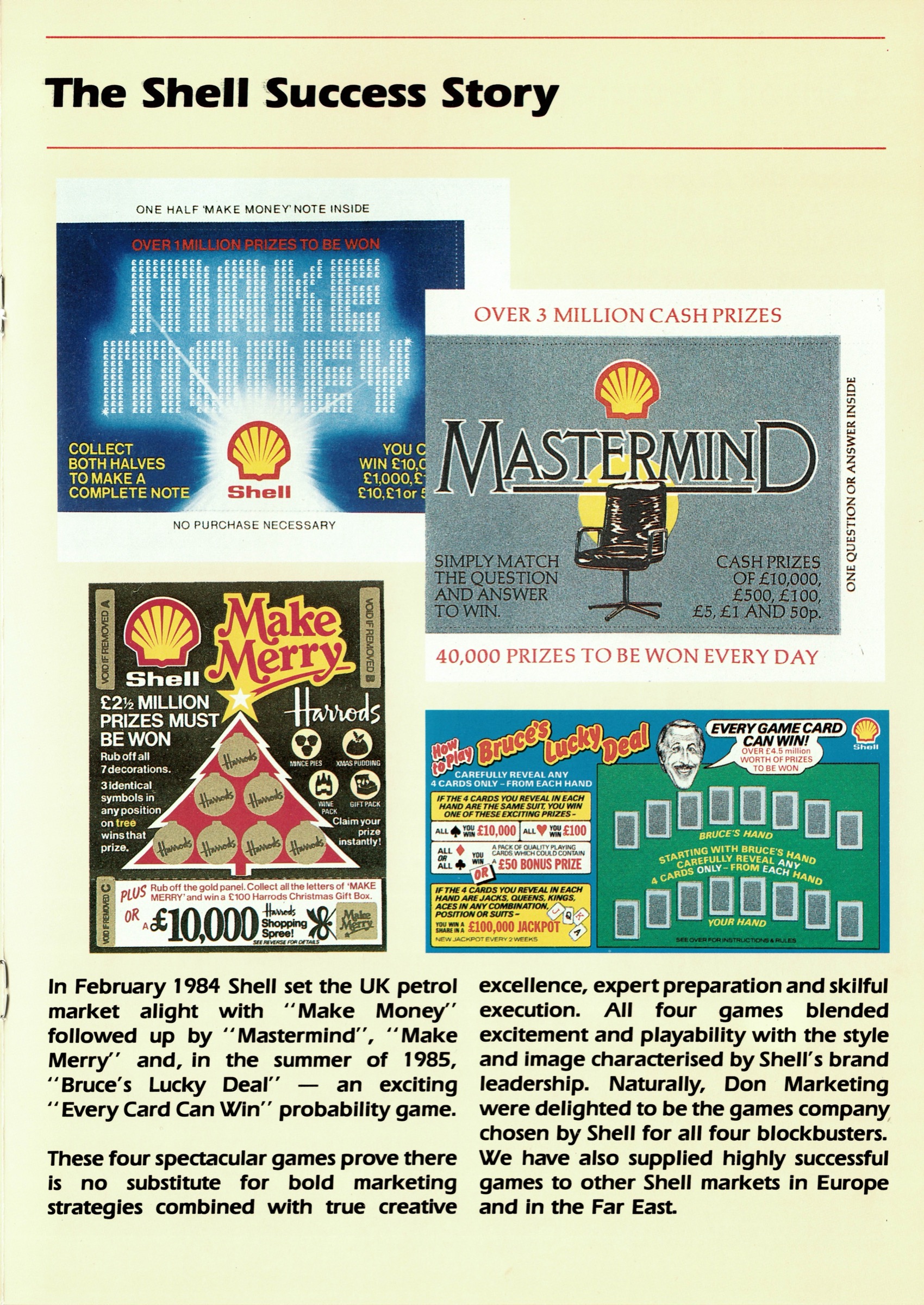
For roughly a decade, the relationship was excellent. Shell was our best client. Our games for Shell set the petrol market alight. Shell Make Money was the blockbuster, but it did not stand alone. There were other promotions too: Shell Mastermind, Shell Make Merry, Bruce's Lucky Deal, Star Trek The Game. They helped make the forecourt feel theatrical rather than routine. Shell Make Money in particular captured motorists' imaginations and attracted the attention of the news media. It also won us an award from the Institute of Sales Promotion. We did not simply print a few game cards and go home pleased with ourselves. We were acting as promotional consultants for Shell in many countries around the world. There was trust. There was mutual benefit. There was success substantial enough to make both sides feel clever.

That fact is central to everything that follows. The later conflict did not spring from a casual or trivial arrangement. It came after years of a wonderful, trusting, mutually successful relationship. That is why the sense of betrayal cut so deep. It is one thing to be treated badly by strangers. It is another to be undermined by people with whom you have already built something real.
My father retired to Florida in 1985 to live with my mother, but the business continued in good shape. We had every reason to think the future would be larger than the past. We were proven. We had range. We had ideas that travelled internationally. We had the kind of reputation that opened doors in London and New York alike. If someone had asked me then how the rest of my life might unfold, I would not have predicted old age spent preserving evidence against a multinational giant. I would have expected more success, more deals, more invention, more comfort, more holidays, and, most likely, more houses rather than fewer.
That is what makes the next part so violent, even though at first it did not look violent at all. Catastrophe in commercial life does not always arrive with sirens. Often it arrives disguised as an ordinary personnel change or a routine meeting. In our case, the atmosphere changed when Shell appointed a new national promotions manager, whom I will call AJL.
At the time, I did not know what I would later come to believe about his relationship with Option One, or about the way Shell contracts could move in directions that made little commercial sense unless something improper was going on. At the time, I only knew that the settled confidence of a productive business relationship had begun to wobble. You rarely recognise the decisive turning point when it first appears. It announces itself modestly and only later reveals that it has taken your future with it.
The moment I truly remember came not in a courtroom or at a negotiating table but one morning with a newspaper in my hands. I opened it and saw an advertisement for a Shell promotion based on a Nintendo Game Boy theme. I was shocked. I telephoned AJL immediately because the promotion struck me as based on an idea I had presented to him in the strictest confidence. During that same conversation, he said something that chilled me in a different way: Shell could run Make Money without us.
That sentence did not yet contain the whole disaster, but it contained the outline of it. Soon enough I would discover that a Make Money game was being printed in North Wales. Soon enough the relationship that had once brought us pride and prosperity would give way to accusations, claims, counterclaims, legal actions, libel actions, settlements, letters, pressure, expense, and a great deal more besides. Soon enough Shell would cease to be my best client and become my defining adversary.
But that comes later.
For now I want to hold on a little longer to the world before the break. The world of ideas. The world in which my father and I were not engaged in a grinding war with power but in the far more pleasurable business of making things happen. The world in which the future seemed open. The world in which Shell, of all companies, looked less like a threat than a triumph.
That is the life I mean when I say I was cheated out of a nice one.
Chapter 2: The Relationship And The Rupture
The relationship with Shell did not begin badly. That is why the rupture hurt as much as it did.
If Shell had always behaved like an enemy, the story would be simpler. I could place the company in the usual category of corporate giant, shrug, and say we had never been foolish enough to trust them in the first place. But that is not true. The reason the break felt like betrayal rather than bad luck is that, for a long time, Shell had been an excellent client. We did good work for them. They did good business with us. There was trust, and not merely the ceremonial kind that appears in polite correspondence and disappears at the first sign of trouble. There was working trust, commercial trust, the kind that grows when people repeatedly rely on one another and profit from doing so.
The direct relationship began in June 1981 after a presentation at Shell-Mex House in London. To a businessman in my line of work, that mattered. Shell was one of the biggest names in the world. A contract with them was not just another piece of paper; it was a sign that one had arrived somewhere serious. Over the years that followed, we created and supplied a succession of promotions for Shell. Some were large enough to make real noise in the petrol market. Some were imaginative enough to travel. Some were successful enough to make both sides feel they had found an arrangement worth preserving.
By the time Shell Make Money came along, the relationship felt mature. We were not outsiders peering in hopefully through the glass. We were trusted promotional consultants with a record. Shell Make Money did not merely tick along respectably. It took off. It caught motorists' attention. It won an Institute of Sales Promotion award. It helped cement the feeling that our partnership with Shell was both commercially potent and, for want of a better phrase, a proper thing. Shell succeeded. We succeeded. That is how good business ought to work.
For about a decade, it did.
That is the period some future reader might be tempted to hurry through on the way to the fireworks, but it must not be hurried. The emotional logic of everything that follows depends on it. I was not some serial litigant haunting Shell from the edges. I was a businessman whose company had helped Shell make money and attract attention. We had built something of value together. I had every reason to assume the relationship, whatever its ups and downs, rested on recognisable standards of decency and confidence.
Then Shell appointed a new national promotions manager, whom I will call AJL.
There are points in life where one only later realises a change in personnel was the beginning of a wholly different story. At the time, the appointment did not arrive with dramatic music. Companies change managers all the time. Titles shift. New faces appear. Structures alter. Business carries on. But from where I stood, this was the start of the wobble. The old stability went out of the relationship.
As I later came to believe, AJL had a personal relationship with a company called Option One, which in my view began benefiting in extraordinary fashion from Shell promotion contracts. On one occasion, as I saw it, they effectively won a race in which they had not even run. It was like watching a horse collect the prize after failing to appear on the course. That sort of thing does not merely annoy a businessman. It corrodes the whole atmosphere around a client relationship. It makes one wonder whether the game is still being played honestly.
The decisive shock came one morning with a newspaper.
I was at home, seated at my desk, on my own, when I opened the Daily Mail and saw an advertisement for a Shell promotion based on a Nintendo Game Boy theme. What made it shocking was not simply that Shell was running a promotion. Shell did that all the time. What shocked me was that the promotion appeared to be based on an idea I had presented to AJL in the strictest confidence and discussed with David Patton at Nintendo. I was astonished and shocked. Then I was furious. I knew at once that something was badly wrong.
I telephoned him immediately.
In that call I raised the obvious concern: how had Shell come to be advertising a promotion that seemed rooted in an idea I had entrusted to him confidentially? I was controlled, but angry, and I think that was obvious to him. I also told him I could send written proof that we had entered into a contract with Shell in respect of Make Money. His response, as I remember it, was effectively that he did not care about being sent anything in writing and was sure Shell could run the promotion without us anyway. During the same discussion, AJL said something I have never forgotten: Shell could run Make Money without us.
That sentence has stayed with me because it contained, in embryo, the whole future. It was blunt, dismissive and revealing all at once. It suggested not merely disagreement over one idea but a deeper corporate assumption: that Shell could take the essence of what we had built together, detach it from us, and carry on regardless. In one line, a decade of mutual success began to curdle into something else. I felt anger, disbelief, betrayal, determination and, mixed in with all of it, sadness. AJL already seemed utterly unlike the people at Shell with whom we had worked successfully for ten years. Even then I had the sense that the relationship was likely to end badly.
Before long a Shell insider friend told me that a Make Money game was under production in North Wales by Dobson and Crowther, a printer that had produced Shell games for us before. That discovery mattered because it turned suspicion into something harder and uglier. One can survive misunderstandings, delays, bruised egos and clumsy conversations. Business is full of those. But the sense that a trusted client has crossed the line from hard dealing into misuse of confidence is different. It strikes not only at profit but at dignity. It tells you that the years you spent building trust may have been, from the other side's point of view, no more than a useful prelude to appropriation.
We did not rush to court simply because we were angry. We tried to be reasonable. As I remember it, we proposed an attempt at mediation and suggested a former Shell manager, John Smedal, as mediator, which he did. Then Shell kept us waiting for its final position until after the Shell Make Money promotion had finished its run. Only days after that, as I recall it, they said there would be no offer to settle. That was when we issued the High Court writ over Make Money. It mattered to me then, and it matters to me now, that we had tried the sensible route first.
What upset me especially was that the quarrel did not stop at one promotion. At one point Shell advanced a claim that it had devised the Star Trek-themed game. I knew that to be false. I had organised that idea in principle with Paramount Pictures, with the licensing agreed, subject to a presentation to Shell. Shell knew nothing of it until I disclosed it. When I later saw Shell claiming otherwise, my reaction was rage and disbelief. It is hard to explain to anyone who has not built things for a living how offensive that felt. This was not merely a disagreement about money or contract wording. It was a drift toward rewriting authorship itself. I was fortunate that there was published material pointing to my role, because by then I had already learned not to assume the truth would simply take care of itself.
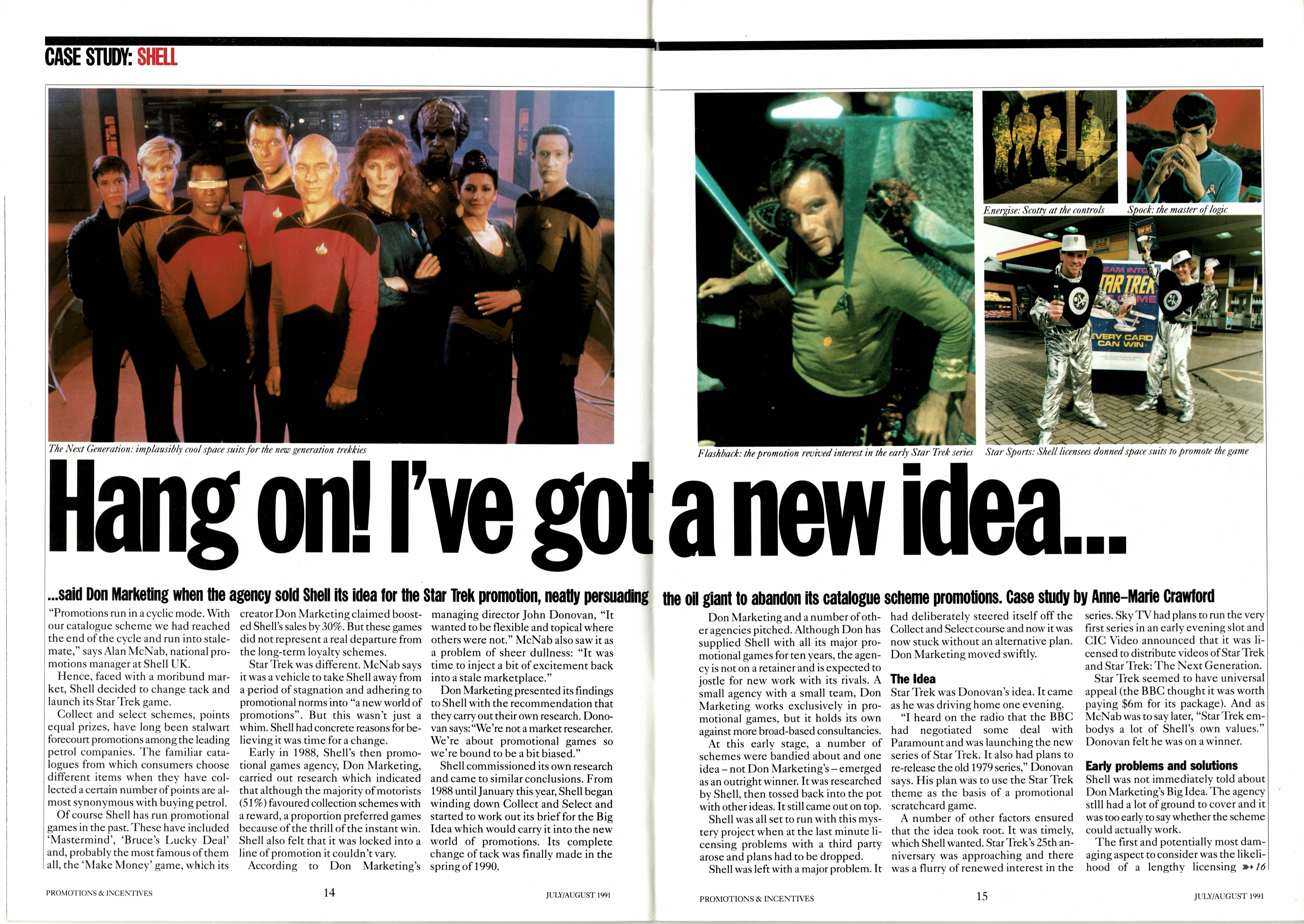
Promotions & Incentives article on the Shell Star Trek promotion, reproduced as evidence of Don Marketing's public connection with the game.
This was the point at which my relationship with Shell ceased to be merely commercial. It became moral.
That distinction matters. Companies are accustomed to price disputes, contractual arguments and ordinary trade resentment. They are less comfortable when the other side insists that the issue is not only money but conduct. From my point of view, that was the issue. We had given Shell ideas, labour, loyalty and success. We had done so under conditions that assumed confidence meant confidence. If Shell or Shell personnel chose to use confidential material as if it were simply lying about ready for the taking, then the injury was larger than a lost piece of business. It was a corruption of the relationship itself.
That corruption did not arrive cleanly labelled. There was no moment at which Shell said, "We are now the villain of your life story." Real life is cruder than that. There were telephone calls, documents, discoveries, denials, assertions, and eventually lawyers. Over the years there would be repeated High Court actions, libel claims, a county court action, Shell counterclaims, settlements, pressure, expense, and repeated attempts by Shell to frame matters differently from the way I understood them. But the emotional truth of it was already present in that earlier moment of shock: the newspaper advert, the telephone call, and the cold implication that Shell could take what it wanted and leave us to protest from the side-lines.
Looking back, I think this is why the dispute never felt to me like a technical quarrel. A technical quarrel can be settled, pocketed and forgotten. This felt like breach of faith. It felt like a large organisation deciding that the rules were more flexible when applied to itself than when applied to a smaller business. It felt like discovering that the word "relationship" meant one thing to us and something far more disposable to them.
For a while, no doubt, Shell assumed that whatever grievance existed could be managed as large companies manage such matters: with letters, lawyers, denials, delay and the sheer advantage of scale. In that sense the company's calculation was understandable, if ugly. Big organisations rely on the fact that smaller opponents tire sooner, spend out sooner, lose heart sooner, and eventually make peace with injustice because the alternative is exhausting.
What Shell may not have seen then was that by breaking trust in the way I believed they had, they were not merely creating a claim. They were creating a witness. They were creating an adversary with memory. They were creating the later man with the archive, the websites, the source files, the documents, the persistence, and eventually even the AI bots. The long war began not with some grand ideological collision but with a breach inside what had once been a happy and highly successful commercial relationship.
So I still use the word betrayal. It is not melodrama. It is the right word.
Shell had been our best client. That was what made the break so devastating.
The legal machine comes next. But before we arrive in the courts, the essential wound is already visible: trust given, trust used, trust broken.
Chapter 3: The Legal Machine
If you ask an ordinary businessman what happens when a much larger company does him wrong, he may give you the official answer: you sue. If you ask the same man again after he has actually tried it, the answer grows less tidy.
During one Shell annual general meeting, my father Alfred put the point publicly in almost those terms. Whenever smaller businesses had problems with Shell, he said, the answer seemed to be: if you do not like our solution, sue us. That may sound perfectly reasonable to people who have never had to finance litigation against a multinational. In practice it is often another way of saying: here is a door you are free to open, provided you are wealthy enough to survive what lies behind it.
Sir John Jennings, to his credit, answered in a way that sounded humane. He said disputes ought to be resolved in a sensible, balanced and objective way, and not in a way that simply reflected the relative size of the two disputants. That was well said. It was the sort of sentence a decent person would hope to hear from the chairman of a great company. It also captured, perhaps without intending to, the central problem. Everything in my experience suggested that relative size was precisely the point.
This was not some obscure local grievance buried in a legal drawer. By 28 April 1997, Shell's General Counsel and Company Secretary, Richard Wiseman, was already writing that Dr Jennings, Dr Fay, and Mr Herkstroter had passed my letters to him. Then, on 14 May 1997, he referred again to my letters to Herkstroter and Dr Jennings, to what had been discussed at the AGM, and said he was personally keeping both Shell U.K. and Shell Transport directors informed of progress in the case. The matter had plainly travelled upward. It was being watched at senior level.
Once my relationship with Shell broke down, the matter did not proceed like an elegant disagreement between honourable parties. It hardened. It spread. It became legal. And once that happened, the atmosphere changed completely. A commercial dispute still leaves room for practical sense, embarrassment, improvisation, perhaps even decency. A legal dispute brings a different climate: letters written as weapons, meanings narrowed to suit the occasion, memory turning selective, strength measured not by who is right but by who can keep paying.
By March 1995 the trade press was already catching the flavour of it. Marketing Week reported that Shell was seeking GBP62,000 security for costs from Don. That detail has stayed with me because it captured the broader reality better than any speech about fairness. Shell was not merely defending itself. It was leaning on the oldest lever available to a larger party: money.
I will spare the reader every writ, pleading and counterclaim. I lived through them; that is enough. But the scale matters. As I remember the tally, there were four High Court actions for breach of contract and breach of confidence, two more for libel, a county court claim, Shell counterclaims, and settlements in which Shell paid the legal costs. This all took years. What had begun as an issue of confidence and fairness became a system, and systems have appetites.
The paperwork itself had a deadening grandeur. There were funding arrangements, writs, defence and counterclaim papers, witness statements, document reports, confidential correspondence, later complaints about how aspects of the case had been handled, and the sort of transcript trail that makes an ordinary businessman feel he has accidentally acquired a second profession in paper. That accumulation matters because it shows the dispute was never just a sulk or a publicity stunt. It was documented combat.
By April 1998 the same trade paper was reporting the High Court writ over the Smart Card loyalty scheme and Shell's public line that it intended to defend vigorously. Dry words on a trade-press page, perhaps. But that is how these battles often look from the outside while they are chewing up the people inside them.
By November 1998, we can see that the legal machine was operating internally as well. A surviving Shell FUEL FOR THOUGHT page headed DEFENDING THE COMPANY'S GOOD NAME AND REPUTATION, together with a staff factsheet called DON MARKETING: THE FACTS, shows Shell presenting me to staff as a man making unpleasant allegations, insisting it was vigorously defending the Smart writ, saying earlier cases had been settled for good economic reasons, and even acknowledging the risk that I could present myself as a 'David' fighting a 'Goliath'. It also defended AJL directly and said Shell was satisfied he had done nothing wrong. That showed the dispute was not confined to court bundles and solicitor's letters. Shell was also shaping the internal narrative about it.
One of the most important things about litigation is that it colonises more than the diary. It colonises the imagination. It becomes the thing around which the family must plan. It changes conversations over breakfast. It changes what money is for. Houses stop being homes and become reserves. Time stops being life and becomes preparation, waiting, cost, delay, response, next move. When people speak casually of going to law, they usually imagine a route to justice. What I discovered was a machine for attrition.
That machine was especially brutal because the imbalance was obvious from the start. I knew we were outgunned. Any sensible man would have known it. Shell had the money, the lawyers, the institutional stamina, and the corporate habit of treating prolonged dispute as a manageable business cost. We had conviction, documents, creativity, and the willingness to keep going far longer than most people would have thought prudent. That sounds romantic in retrospect. At the time it was merely expensive.
I sold two houses to help fund the litigation. My parents sold theirs to pay lawyers. When the money finally ran out, we applied for legal aid and were granted it. Then, as I understand it, Shell intervened with information that led to the legal aid being withdrawn. We sought judicial review, but the Smart case came on in the High Court in June 1999 before the judicial review could be heard, which placed us under still greater pressure. This is the sort of detail that rarely appears in a corporate account of a dispute. Companies prefer the clean outline of principle. The human story is messier: the sale of homes, the exhaustion of means, the sense that one is being required to finance the privilege of resisting a wrong.
At times my family and I felt bombarded with threats. That belongs in the story too. The legal machine does not work only through formal filings. It works through atmosphere. It makes itself felt in the house, at the table, in the nerves, in the sense that ordinary life is being steadily occupied by something colder and larger than itself.
Litigation did not merely cost money. It changed how I saw things. At first one still thinks in the old language: facts, confidence, fairness, resolution. But once lawyers are involved long enough, another language takes over. One begins to hear a company's version of events not as mistaken but as strategic. One notices how often the strongest party's idea of proportion happens to coincide with its own convenience. One sees how quickly a matter that felt morally plain becomes clouded in carefully drafted ambiguity.
One exchange from 1997 has stayed with me more than most. By then Shell's side was no longer arguing only about legal exposure. It was making a much broader claim. In a letter dated 20 May 1997, Richard Wiseman, Shell's General Counsel and Company Secretary, wrote that the moral obligation previously referred to had arisen out of the termination of the long-standing relationship, not out of any particular claim, and that the slate therefore remained wiped clean. He went further: in Shell's view, no further obligation arose from the latest claim, legal, moral or otherwise.
I have never forgotten the phrase "wiped clean." It sounds tidy. Almost biblical, or perhaps hygienic. What it meant in practice was that Shell had arrived at a theory of moral finality convenient to itself. Whatever had happened, whatever remained disputed, whatever further claim or misconduct might emerge, the company could say the moral account had already been settled. In effect, Shell was not merely defending itself. It was declaring history closed.
I rejected that at once, and I still reject it. My response was simple. If Shell management did not know, at the time of mediation, about later matters or further claims, how could any moral obligation arising from those matters have been discharged in advance? A settlement cannot morally cleanse what it never addressed. At least, not in any world I recognise. Shell's argument seemed to reduce morality to administrative convenience. Mine was that morality required the wrong itself to be confronted, not merely filed away.
That difference is one of the deepest fissures in the whole story. Shell's position, as I understood it, was that the relationship had ended, money had changed hands, letters had been exchanged, therefore the slate was wiped clean. My position was that if later or hidden wrongdoing emerged, then the slate had not been wiped clean at all. It had been covered over.
I am not tidying this up with hindsight. The argument was there in the correspondence at the time. I wrote in May 1997 that Sir John Jennings had indicated he had been under the impression the matter had been fully resolved the previous year, but that the March 1997 promotion gave rise to a new claim. I also made the practical point that if Shell management had been unaware of the potential further claim during the mediation, any moral obligations arising from later misdeeds could not possibly have been taken into account. Then, on 21 May 1997, I rejected outright the idea that the settlement was some kind of severance payment or blanket absolution. With respect, I said, that entire line of argument could not be right.
That sentence, too, has stayed with me. It was not grand or literary. It was the practical objection of a man being told, in effect, that his moral account had been closed for him by the very people whose conduct he was still disputing.
The legal machine does not like that kind of objection. It prefers categories. Settled. Unsettled. Confidential. Waived. Defended vigorously. That phrase appeared too. Shell's letters became increasingly crisp in the way only corporate legal letters can be: cool, assured, faintly weary, as if the real impropriety lay not in what had been done but in one's refusal to accept the official view of it. There were warnings about confidentiality. There were reminders that proceedings would be defended vigorously. There were lines drawn around what could be circulated and to whom. There was, in other words, the familiar combination of moral denial and legal containment.
None of this meant that Shell never showed a human face. Sir John Jennings plainly did at moments. There were interventions. There were letters. There was an apology from Chris Fay, which I will come to. But that, too, is part of what makes the story difficult and, I hope, interesting. The company was not a cartoon villain with one expression. It was a machine made of people, some decent, some evasive, some helpful, some ruthless, some perhaps simply doing what large institutions teach their people to do: protect the company first, interpret fairness later.
By the late 1990s, I understood something that has never really left me. A smaller party in litigation does not merely have to prove a case. He has to survive his own case. He has to endure it financially, emotionally and domestically long enough to keep it alive. The stronger party knows that. Whether it admits it or not is another matter.
The reader may wonder why I did not simply give up, take the least awful settlement on offer, and move on. The answer is that in one sense I did take settlements; in another I never could move on, because each time Shell seemed to be treating settlement not as honest reckoning but as erasure. What the company wanted, or so it often appeared to me, was not merely peace. It wanted closure on terms it alone could define. It wanted the slate wiped clean because it had said so.
That is not how justice feels from the losing end of unequal power. That is how power describes justice when it has run out of patience.
By 1999 the matter was heading toward the Smart trial in London, with all the pressure, cost and expectation that implies. The legal machine had done its work. It had consumed money, widened the moral breach, and made even apparent moments of progress feel unstable. The next chapter is about one of the strangest features of the whole saga: apology on the one hand, escalation on the other, and the sensation that even the biggest formal moments never truly ended anything at all.
Chapter 4: Apology, Trial, And Aftermath
One of the strangest things in this story is that I did, in a sense, receive an apology.
Corporate disputes are supposed to move in a line: complaint, denial, lawsuit, judgment, end. Mine never did. A chairman intervened. A settlement was reached. A trial loomed. An apology arrived. More than once it looked as though the matter might settle into some intelligible shape. More than once it slipped away again.
Sir John Jennings was central to several of those turnings. During the 1995 AGM in London, my father Alfred stood up on behalf of the Shell Corporate Conscience Pressure Group and put the point plainly. Shell, he said, had all the money in the world. Smaller businesses could not afford to fight it. There ought to be some fairer mechanism for resolving disputes. At the end of his question he asked whether Jennings would meet us afterwards. Jennings did meet us, and when we spoke he said, it takes two to tango. He could not have been kinder. He said that Shell people he had spoken to about me had all made favourable comments, and he even slapped my father on the back in a warm, friendly way. That small gesture has stayed with me because it made the whole encounter feel human rather than staged. To me, Jennings was the one person at Shell who seemed genuinely prepared to stand by the company's Statement of General Business Principles and act on it. For a time we felt we had found someone at the very top of Shell who was sympathetic, interested in the facts, and willing to help. When he intervened, he did so in a spectacular way. He promised to step in, and a few days later Dr Chris Fay's secretary telephoned inviting me to a meeting.
That intervention led to one of the strangest breakfast meetings of my life. I met Chris Fay privately at Shell Mex House in the Strand. The meeting lasted about an hour and three quarters. Breakfast was served by a uniformed butler, which did rather underline the difference in resources between Shell and me. Fay was a very different character from Jennings: less friendly, more bothered, and deeply frustrated, though not necessarily because of my dispute. This was the Brent Spar period and he seemed to pour his heart out about the pounding Shell had taken from Greenpeace. I kept trying to explain why our claim was valid. Fay, for his part, kept returning to precedent. He told me, in effect, that he could not even offer me GBP10, because if Shell made an offer to me it would strengthen the hand of others with grievances against the company. After an hour and three quarters he asked why I had not told him how much I wanted to settle the claim for. I replied that there was no point doing so if he had already said he would not offer even GBP10. I left that meeting with mixed feelings: sympathy for the man, disappointment in the position, and determination to keep going. He did at least walk me to the front door and thank me for coming.
Soon afterwards, on a bank-holiday morning when we were protesting outside Shell Mex House, Fay sent his secretary down asking whether my father and I would go up and meet him again. I had to buy Alfred a tie so he would look smarter. We went in. One other Shell figure present was David Pirret, Shell's retail manager, who had been the subject of many complaints reaching us from petrol-station operators. My father, who was usually calm, persuasive and beautifully controlled in such situations, said to him in embarrassment-inducing fashion that he did not seem nearly as evil as he had been described. It was completely out of character, and for that reason unforgettable. More importantly, Fay told us that he had been ordered by Jennings to make an offer: Shell would pay our past and future legal costs up to a court hearing. We had never heard of a giant corporation funding the legal costs of a company suing it. We accepted on the spot. The feeling afterwards was relief and disbelief.
That arrangement, the Funding Deed, should have changed everything. Instead it became another of those temporary islands in a much longer storm. I did bump into Jennings again at later AGMs, certainly once at the front door to the building and perhaps twice in all. He was friendly whenever I met him. On one of those occasions he again asked whether I wanted him to intervene, and I told him we seemed to be making some progress with Shell UK Limited and that I would come back to him if there were any problems. Soon afterwards he retired. That was a great pity for Shell and for us. I have long believed the whole history would have been different if he had not retired. As I understand it, once Jennings retired, Shell terminated the arrangement and pushed matters towards mediation instead. The mediation ran for hours into the evening. At some point, as I now recall it, Richard Wiseman asked whether it might help me feel better if there were also a letter of apology. I thought such a letter could be useful, not only to me but to doubting relatives who had begun to wonder whether taking on Shell for so long was brave or merely foolish, and who were understandably troubled by the threats and sinister episodes that had accumulated around the case. Eventually, I am told, Fay had to be pulled away from a dance floor somewhere in London to approve the eventual GBP200,000 settlement.
The apology letter from Chris Fay was one of those strange milestones. It was not a clerk's note, a lawyer's formula, or some grudging procedural concession. It was an apology from the chairman and chief executive of Shell U.K., dated 21 October 1996. In it Fay wrote that some of Shell's dealings with Don Marketing appeared not to have met the high standards Shell set itself and that our long relationship had led us to expect. He also reflected that had this aspect been focused on more than the strict legal issues, the differences might have been resolved more quickly. I have never forgotten that, and I do not intend to pretend otherwise for the convenience of a cleaner narrative. If one is going to accuse a company of behaving badly over many years, one must also be fair about the moments when someone senior behaved better than the rest.
But apology is not resolution. It may recognise injury without repairing it. In my case it sat beside continuing dispute, later arguments that the slate had been wiped clean, and a clear determination within Shell's legal machine to keep resisting.
That is why I have never accepted the suggestion that the matter was all put right long ago. A thing genuinely resolved does not keep returning under fresh names. If it had been put right, there would have been no new claim arising from the March 1997 promotion, no further argument over what remained morally open, and no looming Smart trial.
By the time the Smart trial approached in June 1999, the dispute had already become much larger than the specific moment that first gave rise to it. It was now about conduct, confidence, attrition, and the ability of a major corporation to insist that matters were closed while I was still living inside their consequences. We had already spent years in and around legal proceedings. We had sold property to keep going. We had gone through the exhausting cycle by which each apparent advance seemed to produce a fresh obstacle rather than an end. By February 1999 I was publicly writing that the claim was set down for a three-week High Court trial in June and inviting Marketing Week to attend if it wanted to judge Shell by deeds rather than words. By then the case had acquired the full solemn apparatus of serious litigation: witness statements, document reviews, trial bundles, and all the paper weight by which a quarrel becomes part of the machinery of the High Court.
The approach of trial sharpens everything. It sharpens fear because the abstractions of litigation suddenly become dates, rooms, names, bundles, witnesses and consequences. It sharpens resolve because after years of preparation, compromise and argument, one begins to feel that at least the matter may now be tested under some public discipline. It also sharpens inequality, because a trial is not merely a moral contest. It is a resource contest, a stamina contest, and a psychological contest. A large company arrives with infrastructure. A smaller party arrives with nerves. I did not even have enough money to stay in London for the duration of the trial. My solicitor, Richard Woodman of Royds Treadwell, kindly arranged for me to use his parents' flat while they were away on holiday. I stayed there throughout and walked to court each morning. What I remember most about those walks is determination.
I remember, too, the pressure around legal aid and the judicial review we had hoped to pursue after the withdrawal of that aid. Even now, the sequence carries a particular bitterness. When your funds are exhausted and you seek the assistance meant to keep justice from becoming the monopoly of the wealthy, you discover how fragile even that route can be. Then the Smart case comes on in the High Court before the judicial review can be heard, and yet again the timetable of the larger struggle seems arranged for someone else's convenience. One does not forget such things. They alter your understanding of the word "process."
On the first day at the Royal Courts of Justice, I arrived alone and was surprised to find a newspaper journalist and cameraman waiting at the entrance. I had no warning they would be there. I think the paper was the East Anglian Daily Times, though that needs checking. The next day, as I remember it, there was a photograph of me entering the building. Inside, I met Richard Woodman and my barristers, Geoffrey Cox and Lindsay Lane. I also remember confusion over when the legal representative for Don Marketing, a young man called Nick Gill, was going to arrive. I was almost certainly carrying a briefcase full of papers. The feelings I remember most clearly at the entrance itself are confusion and nervousness. At the end of each day, walking back to the flat, I was still in fighting mode.
Even amid all that strain, there were odd flashes of humanity. Before the trial we had distributed simple coloured leaflets outside Shell buildings in London, dense with text, usually heavy on accusation and short on glamour. Most people avoided them and walked out of their way rather than take one. A few were curious. Shell security watched but, in our experience, were never a problem; Richard Wiseman later wrote to say the people handing out the leaflets had never been any bother. But once the court case was under way, we stopped the leafleting and protest activity and even put a notice on the website saying so. One of those earlier pink leaflets prompted one of the strangest and most touching episodes of all. Judy Moody-Stuart, wife of Shell's group managing director, wrote to my father after reading it. It was not, prudentially speaking, a wise thing for her to do, but I have always seen it as a genuine act of concern for her husband. Alfred replied in the same spirit, explaining the pressure we were under and the family circumstances in which we were living. A couple of days before the trial, she sent a brief handwritten postcard wishing us luck. That postcard was very touching.
The most dramatic courtroom moment came later, at the climax of my cross-examination by Geoffrey Hobbs QC, which as I remember it stretched over three days. Hobbs put it to me that I had forged correspondence between myself and Sainsbury's about a game proposal I had put to Shell. My immediate feeling was disbelief. I denied it at once. Then I heard whispering between Hobbs and Shell's lawyers. The judge said he could hear what was being said and was intrigued. I could make out enough to understand the gist: a motorbike messenger was supposedly on the way to court with documents that would prove my guilt. The judge adjourned for lunch to give this melodramatic evidence time to arrive. Nothing arrived. The next morning, instead, I travelled back to Bury St Edmunds with a court team while they searched the house thoroughly. They found nothing. It was a dreadful episode, not least because I then had to try to explain to my mother, already suffering from dementia, what on earth was happening in her home. She died within months of the trial's end.
The scientific evidence did not bear out some simple story of forgery. In her report of 28 June 1999, prepared for Royds Treadwell, the forensic document examiner Dr Audrey Giles said the questioned 24 July 1990 letters were consistent with correspondence produced at Don Marketing in July 1990. She also made the limits of her report clear. She had seen photocopies, not originals, and did not exclude the possibility of later manufacture if the right materials were available. Even so, her report makes plain that later manufacture would have required the appropriate 1990 style and materials. That is a long way from saying the letters had been proved fraudulent. They had not.
One short transcript extract now in the papers catches something of the atmosphere at the end. In it, amid disorder over witnesses and surrounding events, Mr Justice Laddie says to Hobbs: It may come as a surprise to you, but I am not running this case. That is very apparent. I do not need to improve on that line. It speaks for itself. Whatever else one says about the trial, it was not proceeding in a calm or tidy way by then.
Soon after that, DJ Freeman put forward what really did amount to a peace treaty. We now have both the draft language from 25 June 1999 and the executed 5 July 1999 deed. The draft was presented as a way of promoting peace, drawing a line under the disputes, and achieving a clean break with the past. The final package was tougher than that soothing language suggests. It included a complete propriety clause, a reference to future conduct framed through the Protection from Harassment Act 1997, and a final press statement much less balanced than the earlier draft. All this happened in the closing phase of the trial, at what I remember as the climax of the cross-examination of AJL. My solicitor negotiated a settlement under which Shell paid my legal fees and I received a sum that was useful, but far lower than I might have held out for in happier circumstances. By then I feared the judge was against me. My own legal team thought I was wrong and expected him to find in my favour. I did not share their confidence. If I lost, I feared Shell could bankrupt me and force the sale of the house while my mother was still alive. So I accepted the situation as it was, not as I might have wished it to be.
What deepened my bitterness was what I learned later about the way the settlement was presented to the judge. In a 17 June 2008 email, Richard Wiseman referred to Shell's payment of my legal expenses as the information which did not go to the judge. I can say this plainly: I was the sole person bringing the action, and I certainly did not instruct Richard Woodman to hold back any settlement information from the judge or agree to such a course. That does not prove exactly who gave the instruction, but it narrows the field sharply. We also now know that the final deed required the parties to stop representing that anyone involved had acted with anything other than complete propriety in relation to the disputed matters. The final press release said I had abandoned the Smart and libel claims, acknowledged they were without foundation and should not have been brought, and withdrew my allegations of impropriety. Shell, for its part, acknowledged that the proceedings had been brought in good faith and withdrew allegations of impropriety made in the course of them. The settlement package also included a separate deed between Shell, my solicitors Royds Treadwell, and me, under which Shell agreed to pay GBP107,000 in reduced fees, with confidentiality obligations and the charge over Maplebank still hanging over the arrangement. That separate deed now looks to me like a serious candidate for the settlement-related document later said to have been withheld from the judge. My own view is that, if it was not withheld on my instructions, the obvious inference is that the withholding came from Shell's side or the lawyers acting for Shell. For the purposes of this book, though, I must still present that as an inference unless a document says so directly.
Yet the judge still insisted on making what were called judge's comments at the end of the trial. We now have a surviving typed copy dated Tuesday 6 July 1999, and even the recoverable text is enough to show the seriousness of what was being alleged: perjury, forgery, and conspiracy / pervert justice all appear in it. That does not settle every detail of the sequence, and I would still like a cleaner transcript copy. But it does confirm that my memory of the comments as grave and explosive was no embellishment. In those comments, as I later read them, the judge praised AJL and accused me of very serious misconduct. Geoffrey Cox responded furiously in open court. Shell, by my recollection, kept largely out of the clash and said hardly a word. I knew nothing of any of this at the time because my lawyers thought it best not to tell me. Only later did I grasp how heated it had become. It felt less like justice than like a club of professionals quarrelling over terms to which I was not fully admitted.
That is why I did not come away from the Smart trial feeling that I had survived some stern but honourable process. I came away feeling I had been cheated out of justice. The settlement did pay the lawyers, which mattered because I had given them a charge over the house and they must have been relieved. But the money was not enough to save us as I had hoped. It kept me afloat for a while, no more. The house went. My mother died while it was on the market. It had been her favourite house, and the last one she would live in. We moved into rented accommodation in Colchester. I carried with me not triumph, and not even simple relief, but a mixture of relief, frustration, exhaustion and disappointment, with one conclusion above all: the matter was not truly over.
What I had wanted from the Smart trial was not only vindication. I wanted the matter to stop mutating. I wanted to endure the thing and at least know the shape of the battlefield. Instead I learned what so many long corporate disputes teach the weaker party: a major event can be absorbed into a larger pattern of non-closure.
That is the peculiar exhaustion of it. A trial that ought to settle matters becomes another episode. An apology that ought to repair matters becomes one more exhibit in the argument. A settlement that ought to close the file becomes the basis for a later claim that everything had already been wiped clean. Those moments mattered enormously because they altered real finances, real family decisions and real lives. But with hindsight they also reveal something darker: a big company does not always have to win cleanly. Often it only has to prevent a smaller opponent from ever reaching a truly finished state.
That, to my mind, is what makes the story so morally corrosive. If Shell had simply said no at the beginning and remained brutally consistent, the terms of battle would at least have been clear. Instead there were gestures, interventions, partial recognitions, denials, settlements, further disputes, and the endless suggestion that the matter had somehow already been dealt with. It is hard to build peace on top of that kind of instability. It is hard to be told both that one has been wronged and that one has no remaining moral ground on which to stand.
There were people within Shell who behaved more decently than others. I have said so already and I will say it again. Sir John Jennings, in particular, seems to me to have acted more fairly than many others did. I say that because this book ought to be truthful, not merely angry. But it is equally truthful to say that the company as a whole never translated those better moments into a final, durable act of repair.
That failure is one of the reasons the dispute escaped its original bounds. If the apology, the settlements and the trial period had led to a genuine end, there might never have been the websites in the form they later took, never mind the leaks, the archive, the later campaigns and the bot wars. The afterlife of the dispute was not an accident. It was created by the absence of convincing closure.
I sometimes think this is the point at which my life divided into two versions. In one version, the apology is followed by proper redress, sensible conclusion and an eventual return to ordinary ambition. In the other, which is the version I actually lived, apology becomes one more document in a much larger archive, and the archive becomes a second life.
The tragedy of that second life is that it contained real energy, real skill and even, at times, real public value. It exposed things. It helped others. It embarrassed a powerful company. But it was not the life I had intended to build. That is why I resist any romantic reading of my persistence. Persistence can be admirable. It can also be the shape imposed on a man when institutions will not do the obvious thing and bring a wrong to an honest end.
By the close of the 1990s, I had learned a bitter lesson: even when a large company appears to concede something, apologise for something, or engage with something, that does not mean it has accepted the deeper obligation to put matters right. It may only mean the story has entered a new phase.
The next phase, for me, was the long shadow world of surveillance, leaks, inside information and public record: the stage at which the dispute stopped being just a legal fight and became an archive.
Chapter 5: The Shadow Archive
There comes a point in a long dispute when paper stops feeling like paperwork and starts feeling like oxygen.
That point arrived after the legal years had done their damage and the matter showed no real sign of dying. By then I had learned a hard lesson. If you are dealing with a large company, memory is not enough. Everything must be kept, dated and retrievable: letters, pleadings, notes, press cuttings, witness statements, internal documents, leaked emails, legal threats, apologies, and all the other fragments from which a truer picture might later be assembled. What might have looked like obsession from the outside was, from where I stood, a survival method.
One reason I learned that lesson so completely is that even the apparent peace after the Smart trial did not hold. After the sale of the house and the move into rented accommodation, I spent a couple of years helping a relative in the IT world. Some of that period took me to Florida, which I remember as peace in a pleasant environment with good food. None of it had anything to do with promotional games. That was precisely the point. It felt, for once, like life moving in another direction.
Then the old pattern returned, and this time the documentary trail is unusually clear. In August 2001, a company called injini, linked to my family, explored the possibility of an internet-only Make Money game with no physical pieces involved. I saw it as a possible second act, perhaps even a way of restarting my career. As a matter of courtesy, and caution, the proposed venture was put to Shell in advance. On 17 August 2001, Richard Wiseman replied that the plan would fall within the old 1994 settlement and that proceeding would breach it. I later supplied further explanation, arguing that a paperless online version in cyberspace was a different creature altogether. Shell did not soften. Keith Ruddock repeated the company's hard line.
Then came the detail that, to me, changed the moral temperature of the whole exchange. On 7 September 2001, Wiseman told my nephew Steven Donovan that Shell was exclusively entitled to Make Money, reserved the right to stop the venture or claim profits, and referred to the judge's remarks from the Smart trial, adding that he would be happy to send a transcript. That is not some later embroidery. It is there in the correspondence. The implication was obvious. The old reputational poison, which I believed had already been neutralised by the deed's complete propriety clause and by the released press statement in which Shell withdrew allegations of impropriety made in the course of the proceedings, was being brought out again.
The effect was predictable. injini's own press material said that, in the face of Shell's threats of legal action, it had abandoned for the time being its plans for the first online Make Money game. So this was not only a matter of feeling insulted or threatened. A real opportunity was being chilled in real time.
When Wiseman later realised that clause 4 of the Deed of Compromise might itself prevent him from sending the judge's remarks without my consent, the absurdity became almost comic. But it was not funny to me. I told him he had poisoned my relationship with injini and put Shell in repudiatory breach of the agreement. I notified Malcolm Brinded. I notified Phil Watts. I told them we were back to square one. I repurchased shell-shareholders.org and prepared to relaunch the site. Shell denied any breach. I did not accept that denial. As far as I was concerned, the peace treaty had been torpedoed.
That matters because it explains why the archive and the website became not merely habits, or outlets, but necessities. If even a supposedly settled set of allegations could be revived when useful, then every piece of paper mattered. Nothing was safely past.
Shell had taught me to distrust the official version of events. Once you have lived through years in which a powerful company can be conciliatory in one letter, aggressive in the next, moralising in public and legalistic in private, you stop assuming that the truth will take care of itself. You keep things because one day the smallest scrap may prove to be the hinge on which a larger argument turns.
The archive accumulated. At first there were the obvious categories: contracts, drafts, promotional ideas, court papers, correspondence. Then there were the materials of any public campaign: articles, letters to editors, notes from journalists, records of conversations, speeches and AGM questions. Over time, another category became more important still: material from inside Shell itself.
This is where the story enters murkier territory, and I must be careful. Not every allegation can be proved to the same standard. Not every source can be identified. Not every internal document is self-explanatory. Yet it would be false to leave out the basic fact that over the years a stream of internal Shell material reached my father and me, and later our websites. Some came through formal channels such as subject access requests. Some came from whistleblowers, current or former employees, or people close to events who believed the public story was incomplete. Some of it was banal. Some of it was astonishing. All of it increased my sense that the dispute was larger than the company had ever admitted.
Once that starts happening, the nature of a campaign changes. You are no longer simply arguing with a corporation from the outside. You are reading its shadow. You are glimpsing how it describes you when it thinks you will never see the description. You are discovering who inside the machine is anxious, who is contemptuous, who is rattled, who is trying to "kill the story," who thinks your website is ridiculous, and who quietly admits it is better than their own internal communications. Those are not the sorts of revelations that soothe a grievance. They deepen it.
One reason they deepen it is that they expose a second battle running behind the visible one. The first battle is public: statements, lawsuits, websites, media coverage, annual meetings, formal correspondence. The second battle is private: monitoring, internal assessments, leak-hunts, quiet containment, and the effort to work out who is talking to whom. At various points, material that later came into my hands suggested that Shell was paying serious attention to my activities, my father's activities, our website, and the possibility that employees or insiders were providing us with information.
By 2007 this seems, on the face of internal materials later cited on the Donovan sites, to have become especially intense. There are references to March 2007 internal emails, a round-table response, and a broader concern inside Shell about what the Donovans might do with sensitive subjects or newly emerging information. There are later references to confidential Focal Point reports and to internal concern about employees taking "internal laundry" to Donovan. There are suggestions of a global effort to identify leaks. Some of this material is heavily redacted; some of it requires contextual caution; some of it sits awkwardly between what can be stated confidently and what can only be inferred. But the pattern is still revealing. Shell did not behave as if we were irrelevant.
For years I was often portrayed, explicitly or implicitly, as a nuisance on the margins. Yet nuisance figures are not usually tracked with this sort of attention. Nuisances are brushed away. What appeared to trouble Shell was not simply that I criticised the company but that I preserved things, published things, connected things, and sometimes received things it would clearly have preferred to keep inside the building.
There is an old saying that sunlight is the best disinfectant. It sounds noble. In practice, sunlight creates its own dangers. When people trust you with information about a powerful employer, or a powerful former employer, you acquire obligations that are partly journalistic, partly moral, and partly strategic. You must decide what can safely be published. You must try to establish whether a document is genuine, complete, or manipulated. You must consider whether disclosure serves truth or merely noise. You must also think about your sources, who may be frightened, reckless, disillusioned, or all three at once. The romance of the whistleblower vanishes quickly when one realises the actual work consists of protecting people, checking facts, and bearing the weight of things you may not yet be able to use.
I do not pretend I always navigated that world elegantly. But I can say with confidence that it changed me. The legal years had made me stubborn. The archive years made me methodical. I became less interested in argument for its own sake and more interested in records: who wrote what, when, to whom, under what heading, with what hidden assumptions. The archive was not only a weapon. It was also a discipline, a way of forcing myself to move from outrage toward evidence.
So the story cannot be reduced to paranoia. If all I had possessed were suspicions, the chapter would be shorter and far less persuasive. What made the archive powerful was that it so often contained the company's own words. Even a shell of redacted internal correspondence can still reveal a great deal. An accidentally disclosed email can be more instructive than a hundred public statements. A note intended for internal circulation can expose tone, fear, contempt, flattery or alarm in ways no polished press release ever will.
Some of the most striking material from these years concerns the changing role of the website itself. Inside Shell, it appears at times to have been treated not merely as a gripe site but as a live reputational problem. One internal comment later disclosed said, in effect, that the Donovan website was an excellent source of group news and comment and superior to what Shell's own internal communications were putting out. I have always treasured that line, partly because it is funny and partly because it reveals something very serious. The company knew the site had become useful. Perhaps more useful than it wanted.
And usefulness attracts surveillance.
Here it is necessary to tread carefully again, because the subject of espionage has a tendency to excite both believers and sceptics beyond reason. The book must not become silly. What can responsibly be said is that the Donovan archive and associated websites became entangled over time with materials and allegations touching on private intelligence, internal security, covert monitoring, and efforts to identify or contain leaks. Hakluyt appears in this world. So do corporate-affairs and security structures. So do former or current insiders with intelligence backgrounds. Some episodes are better documented than others. Some are still best presented as allegations, reports, or John's understanding of events. But taken together they create a persistent impression that the conflict had long since escaped the boundaries of ordinary commercial disagreement.
When the surrounding conduct begins to feel shadowy, paperwork becomes moral ballast. It is how one resists being gaslit by scale. It is how one protects oneself against the later suggestion that everything was imagined, exaggerated or invented. The archive says: this was written; this was said; this was sent; this existed; this happened on this date.
There was a more human reason too. The archive gave the years shape. A long grievance can dissolve a person if it remains purely emotional. Archiving turns suffering into labour. It gives one a task beyond fuming. It allows anger to become curation. That is probably one reason I did not collapse into self-pity. I was busy. If Shell would not end the story, I would document it.
Of course that had a cost. Archiving a fight is not the same as escaping it. There are only so many hours in a day. Time spent scanning, filing, cross-checking, publishing and protecting is time not spent elsewhere. One of the quiet tragedies of this whole saga is that the skills I poured into the archive were real skills. They involved organisation, judgment, communication, persistence and nerve. In another life they might have built something gentler. In this life they built a record of what Shell had done and how it had responded when challenged.
By the end of this period, I was no longer just a litigant with a grievance or even a shareholder with a campaign. I had become something else: an unofficial archivist of Shell's discomfort. That is not a title I ever sought, but it explains the next stage. Once you possess not only an argument but an archive, the internet changes from a noticeboard into a weapon.
The websites came next. And once they were fully alive, the story changed again.
Chapter 6: The Web Counterattack
If the archive gave me memory, the internet gave me reach.
For me, this was the great change. For years my conflict with Shell had passed through the usual channels: meetings, calls, letters, solicitors, actions, counteractions, settlements, threats, and all the clogged Victorian plumbing of corporate dispute. Then the web arrived, and with it the possibility that a smaller party no longer needed permission from newspapers, courts, or institutions in order to publish a record. That possibility changed my life almost as much as the original wrong had changed it.
At first glance, the move online can look like a simple act of retaliation. Wronged businessman creates anti-Shell websites, posts documents, embarrasses oil giant, story ends. That version is too shallow. The websites were certainly a counterattack. But they also became an archive, a newspaper, a filing cabinet, a tip line, a pressure tool, a memory bank, and eventually a kind of public utility for people who wanted to understand Shell from somewhere other than Shell's own polished surfaces.
I could not have done this alone. Years earlier I had placed an advert in a local paper for a computer whiz kid, and only one young man replied. That was Nick Gill. Over the next thirty years he became not only my IT adviser but a close friend. From the beginning of our internet activity in the mid-1990s, Nick built the Shell-focused sites and kept them running. The internet was not magic. It required skill, patience and maintenance, and Nick supplied all three. Movements of one kind or another often look, in retrospect, as though they assembled themselves. In reality they are built by hands.
The first achievement of the websites was simple visibility. Instead of pleading for access to somebody else's platform, I had my own. Documents could be posted. Letters could be quoted. Timelines could be built. The company's statements could be preserved beside contrary evidence. Journalists could find material without waiting for a formal package. Shell insiders, disillusioned employees, activists, litigants, and the merely curious could see that someone had built a running public record of the company's difficulties, contradictions and vulnerabilities. By September 2001, after the injini rupture and my formal assertion that the deed had been repudiated, shell-shareholders.org was back in play as part of that new phase.
By then the rented house in Colchester had become less a refuge than a campaign centre. Most days consisted of emails and website work, with some phone calls and the occasional visitor. Journalists came. Broadcasters came. Law firms came. Even Greenpeace came. For me the work had become a discipline as much as a campaign. It kept my mind busy. Use it or lose it.
At some point, that public record became embarrassing in a new way. It was no longer merely the work of a grudge-bearing former business partner. It became useful, and usefulness is dangerous. One internal Shell email later disclosed reportedly recommended royaldutchshellplc.com as a better source of group news and comment than Shell's own internal communications. Few compliments in my life have been stranger or more satisfying. It was satisfying because it was involuntary. It was strange because it confirmed how far things had moved. What had begun as my platform against Shell had, in some respects, become a platform Shell people themselves found worth reading.
That is when the websites ceased to be only an outlet and started to feel, if not exactly like an institution, then at least like infrastructure.
The domain name battle made this transformation visible to outsiders. royaldutchshellplc.com was not just any web address. It was a symbolic insult, a provocation, and a declaration that a giant company could be made to confront its reflection in an unfriendly mirror. The idea of registering the name was mine. I put it in my father Alfred's name because he was in his late eighties and I knew that detail would add absurdity and force to the story. It did. Before long, the Wall Street Journal was on the phone. Alfred ended up with a pencil sketch alongside the article and was overjoyed. I was delighted for him, and not displeased to be mentioned myself. Shell's attempt to recover the domain through WIPO in 2005 then became a story in its own right.
What I remember most about the WIPO result is astonishment. We had expected trouble. We had not expected to win. Yet the decision went our way. I first heard by email from WIPO itself. One of the first things we did was send warm thanks to the American domain-name expert Paul Levy, who had contacted us after reading the Wall Street Journal article and, without asking for a penny, supplied case law and invaluable advice. The victory felt mischievous, strategic and triumphant all at once. More than that, it gave us a low-cost platform from which to castigate Shell using the name of its own new company. There was, as I saw it, egg all over the corporation's face.
One of the strangest consequences of that domain saga was practical rather than symbolic. Emails intended for Shell began arriving through my site. Some were obvious rubbish. Some were not. In November 2007 I wrote to Shell's Company Secretary and General Counsel, Michiel Brandjes, asking whether he wanted every item forwarded or whether I should simply delete obvious junk. His written reply was surreal. I need not bother forwarding obvious spam, he said, but in case of doubt Shell would prefer to receive the email so that appropriate attention could be given to it. There it was in black and white: one of Shell's most persistent critics had, in a limited but genuine sense, become part of Shell's unofficial communications chain. As far as I understood it, that odd arrangement was never formally withdrawn.
But the deeper change lay elsewhere. The site became a meeting place for material that would otherwise have remained scattered and perishable. Leaked emails found a home there. Public-interest appeals found a home there. Journalists hunting context found a home there. Evidence helpful to shareholders, campaigners or critics found a home there. It was used not only for my own conflict but by others who had their own reasons for wanting Shell scrutinised more closely.
It carried appeals or information connected with WWF, ECCR, campaigners focused on Sakhalin, public-interest researchers, shareholder actions, disgruntled employees, and others with grievances or evidence. The details differ from case to case and each needs checking in its own right. But the broad point is clear enough: the site became a public-interest hub. Shell may have preferred to imagine it as one man's obsession. In practice it became a service.
That shift matters morally. A purely private vendetta is easy to dismiss. A platform that others use because it is useful is harder to wave away. That does not automatically make everything on it true, fair or complete. No serious person should pretend otherwise. But it does suggest that the site filled a gap. People came because Shell's own channels did not satisfy them, or because the official story felt too managed, or because they needed an audience that would not reflexively defer to the size of the company.
The media noticed this. Prospect found the site essential reading for those covering Shell and the energy sector more broadly. By 2009 the Guardian was calling it one of the oldest and most effective gripe sites and describing my ninety-two-year-old father, Alfred, and me leafleting outside Shell's London headquarters even though the site had already logged more than two million hits in a month. Reuters treated it as a conduit for whistleblowers. The Financial Times described it as a thorn in Shell's side. The Times wrote of Shell being "at war" with the Donovan family. All of this helped make the oddness of the story visible: a father and son, and then later a lone son with an expanding archive, causing repeated reputational pain to one of the world's largest energy groups.
The leaflets themselves were never glamorous. They were simple coloured flyers, usually crowded with text, often topped with headlines and only occasionally a picture. Most passers-by would not take them and swerved away rather than be handed one. A few were curious. Fewer still spoke up for Shell. Security staff watched, but they were not the problem. The point was not street theatre in the romantic sense. The point was persistence. The internet gave the campaign reach, but the leaflets gave it bodily presence. Shell could not say it had all vanished into cyberspace.
There is a temptation to turn these years into a triumphalist story about humiliating Shell online. There is some truth in that, and I would be dishonest if I denied the satisfaction involved. But triumph is too simple an emotion for what was happening. The websites existed because earlier routes had failed. They were proof of persistence, yes, but also proof of unresolved injury. I did not build them because my life was going splendidly and I fancied a hobby. I built them because a large company had taught me that memory without publication was vulnerable.
There was also labour involved on an almost absurd scale. Tens of thousands of Shell-related news items, documents, leaks and commentaries were posted over the years. That volume itself tells a story. It says something about my stubbornness, certainly, but it also says something about the scale of Shell's own ability to generate controversy, hypocrisy, contradiction and grievance. A company with a cleaner history would have made my task much more difficult.
The websites also changed the emotional balance between Shell and me. In litigation, Shell was always structurally stronger. Online, the balance shifted. The company had more resources, but I had nimbleness, memory, motive and a willingness to keep publishing. Shell had boards, committees, legal teams, reputation managers and press departments. I had a source trail, an archive, a sharpened sense of the company's weaknesses, and increasingly an audience that understood I was not simply making things up. Online, the giant had to chase.
That did not make the power equal. It did make it less one-sided.
It also created a new kind of fear inside Shell. When information is centralised and disciplined, companies can survive embarrassment. When information leaks into a hostile but document-rich ecosystem that updates constantly and attracts journalists, activists and insiders, embarrassment becomes harder to contain. Every internal email risks external life. Every contradiction risks being placed beside an old promise. Every new scandal can be connected to an old pattern. The website gave continuity to Shell's discomfort.
The most unexpected part of all this, at least for me, is that helping others became part of the mission. Over time the site ceased to be only about my own dispute. It became a place where people with their own Shell stories could seek publicity, solidarity, context, or occasionally practical help. That broadened the meaning of the campaign. It made it less lonely. It also made it harder to stop, because by then stopping no longer felt like merely ending my own quarrel. It felt like dismantling a platform that other people had come to rely upon.
The visitors to Colchester made that change tangible. The one I remember most strongly is Esther Kiobel, widow of one of the Ogoni Nine. She came with the weight of her own Shell story, but what I remember most vividly is not first the legal complexity. It is the humanity of the visit. She brought me some wonderful multicoloured ties. My family and I all took to her at once. She was warm, friendly and, it scarcely needs saying, no fan of Shell. Moments like that made the campaign feel less like a private fixation and more like part of a larger community of people who had seen too much of the same company from the wrong end.
Shell may have misunderstood me for a long time. From inside a large institution, a critic is often reduced to a personality type: crank, obsessive, enemy, nuisance. But the websites gave my campaign function. Function is much harder to dismiss than temperament.
By the time the domain battle, the media coverage, the insider leaks and the third-party appeals had all passed through the same web infrastructure, a new reality had formed. I was no longer just a man who said Shell had wronged him. I was the keeper of a growing alternative record of Shell itself.
That record would prove powerful in the years that followed. It would feed later revelations, later campaigns, later embarrassments, and eventually even the strange AI-era bot wars with which this book began.
But before the bots came, there was another, quieter transformation. The websites had made me public. The fight was no longer only mine.
Chapter 7: The Bot Wars
If somebody had told me, during the early Shell promotions, that one day I would spend part of my old age feeding forty years of corporate history into artificial intelligences, I would have assumed they needed lying down in a darkened room.
Yet that is where the story arrived.
I should admit the oddity of it at once. This campaign began in the era of meetings, paper files, telephones, telexes, witness statements and petrol-station promotions. It has ended up in an age where one can put the same question to several machine systems at once and watch them produce overlapping, contradictory, evasive or unexpectedly candid accounts of the same underlying dispute. It is absurd. It is funny. It is faintly dystopian. It is also, from my point of view, useful.
The idea came to me in the way many of my ideas have come over the decades: suddenly and without ceremony. Why not ask the machines? Why not give ChatGPT, Copilot, Grok, Perplexity and whichever other silicon oracle happens to be fashionable the same material, or near enough the same material, and see what they did with it? Why not compare the answers? Why not publish the comparisons? Why not make visible, in public, the strange new fact that even artificial intelligence cannot quite smooth away the afterlife of this dispute?
That was the beginning of what I came to think of as the bot wars.
The phrase should not be taken too grandly. No one was launching missiles from a shed in Essex. The bots were not combatants in any literal sense. They were tools, mirrors, amplifiers and, sometimes, accidental comedians. But the tactic was real enough. I would pose similar questions to multiple systems about Shell, about my history with the company, about the archive, about legal episodes, about allegations, about public scandals, about the relationship between my websites and Shell's reputation, and then compare how each system handled the terrain. Sometimes they agreed. Sometimes they hedged. Sometimes one would say plainly what another wrapped in managerial cotton wool. Sometimes a model would rediscover old journalism that deserved to be remembered. Sometimes it would hallucinate nonsense. Even the mistakes could be revealing.
The first system I used seriously in this way was ChatGPT, and I owe that, in turn, to Nick Gill. By then Nick had been part of my life for roughly thirty years. We had first met because of that old advert for a computer whiz kid, and in the years since he had become both my IT adviser and a close friend. It was Nick who later drew my attention to ChatGPT, explained what it could do and helped me go on using not just that platform but the others that followed. So even this ultra-modern phase of the story has roots in an older act of faith in one clever young person answering an advert.
What impressed me first was not some grand philosophical revelation. It was practical magic. I could ask ChatGPT to create articles about Shell and, provided I was careful with the prompt, it would produce something useful in seconds rather than the far longer time it would take me to draft manually. I made one rule clear from the beginning: it must be truthful and must not invent false facts. That had always been my own position anyway. It is probably one reason why, after all these years of battling Shell, I have not found myself successfully sued for libel. The machines were only welcome in my campaign on the understanding that they served the same caution.
I should be careful here. AI output is not evidence in the same sense as a document, a letter, a court paper, a contemporaneous article or an authenticated internal email. A chatbot is not a witness and certainly not a judge. These systems remix existing information. They guess. They blur. They fill gaps with confidence. They are capable of regurgitating an old truth and a fresh error in the same paragraph. Anyone using them seriously must keep both hands on the railing.
But precisely because they are imperfect, they expose something interesting about the modern information environment. If you feed them decades of public reporting, archived pages, leaked material, corporate statements, legal history and commentary, they do not produce a single stable official narrative. They produce a struggle over narrative. They reveal what has entered the record strongly enough to survive. They reveal what remains disputed. They reveal how a long-suppressed or long-mocked story can suddenly become machine-readable and therefore newly difficult to bury.
In my case the archive mattered enormously. Without the decades of preservation, there would have been much less for the machines to chew on. The bot war was not magic. It was a late dividend from old labour. All those years of keeping papers, publishing material, building websites, preserving correspondence, recording episodes and refusing to let memory be tidied away by corporate convenience had created a digital body of evidence and narrative. Artificial intelligence did not create that body. It merely began ingesting it.
The real shift came when I stopped using AI as a fast drafting tool and started using it comparatively. Being creative, I tried the same or similar material across multiple systems and watched how the answers differed. I looked for agreement, for contradiction, for evasions, and especially for hallucinations. Then I turned the comparisons themselves into publishable material. That was the excitement of it. I felt I was doing something nobody else was doing, and the old part of me that has always been an ideas man was suddenly alive again. The archive was no longer static. It could be mixed with current news, republished in altered form, picked up by other systems, and returned to the internet as fresh fuel. In the simplest terms, I had realised that these large public AI systems treat the internet rather like a weighted archive. If you dominate enough of that archive, you can begin to shape what the machines say back.
One of the odder features of this phase is that the machines sometimes described the tactic rather well themselves. In January 2026, Grok called it a masterclass in digital persistence. I would not want to lean too heavily on the compliment, not least because it came from yet another machine rather than a flesh-and-blood critic or admirer. Even so, the phrase was apt. What I was doing was not simply asking clever questions. It was persistence, iteration, republication and comparison, carried out often enough that the archive stopped behaving like dead storage and started behaving like a living pressure system.
So the bot wars are not just a gimmick. They dramatise a serious change in power. For most of my struggle, if a company wished to contain a story, it could lean on the usual bottlenecks: editors, publishers, lawyers, broadcasters, institutional caution, fatigue, expense, passage of time. Now there is another arena in which the story can recur. Ask a question often enough, in enough systems, against enough archived material, and the dispute reappears. Perhaps clumsily. Perhaps incompletely. But it reappears. The old hope that time alone would bury everything becomes harder to sustain.
There is also a theatrical pleasure in it, and I would be hypocritical to deny that. After so many years of being lectured, threatened, legalised, patronised or dismissed, it is satisfying to watch machine systems struggle to give neat answers about Shell and the Donovan feud. One bot leans cautious. Another is blunter. A third reproduces the tone of a nervous corporate lawyer. A fourth seems almost to enjoy the scandal. They do not merely answer. They expose the fact that the underlying material is awkward.
That awkwardness is part of the strategy. When multiple systems, using different training mixes and different guardrails, converge on the view that there is a real, long-running, reputationally damaging history here, that matters as public theatre even if one must still verify every factual proposition by more conventional means. And when the systems diverge, that matters too, because the divergence shows where the record is muddy, where advocacy has outpaced proof, where legal finality collides with moral dissatisfaction, and where the modern internet turns everything into a contest of summaries. The machines, in their own clumsy way, ended up explaining my innovation back to me: what had once been man versus corporation had become archive plus AI versus corporate silence.
In that sense the bot war is partly experiment and partly pressure tactic. I have never pretended otherwise. It is experiment because I genuinely want to see what these systems will surface, distort, omit or rediscover. It is pressure because the outputs can then be published into the same online ecosystem that I have been building for years. What was once a file in a drawer became a web page. What was once a web page became training material. What was once training material becomes, in effect, a fresh public conversation. Shell is not confronting only my memory now. It is confronting the possibility that my archive has entered the bloodstream of machine-mediated public knowledge.
That helps explain why even a renewed legal threat, or the suggestion of one, feels different in this environment. In earlier years, a threat could intimidate by targeting a document, a publication, a person, a host, a domain, a meeting. In the AI era the terrain is more diffuse. The archive exists in multiple places. The commentary exists in multiple places. The models ingest fragments from everywhere. Even if a company objects to a particular post or formulation, the broader problem remains: the history has become distributed. One cannot easily send a stiff letter to the whole future.
None of this means Shell is helpless. Large companies still possess money, lawyers, influence and patience. They still benefit from public fatigue and the tendency of outsiders to assume that any dispute which lasts this long must be, in equal measure, both sides' fault. Artificial intelligence does not dissolve corporate power. In some ways it may reinforce it. Models can be timid. They can understate. They can flatten moral complexity into bland neutrality. They can treat deep asymmetries as a polite disagreement between parties. I have seen that too.
But even that can be instructive. When a model reaches too quickly for symmetry, one begins to see how modern discourse protects large institutions by default. When it retreats into lawyerly vagueness, one is reminded how much of public language is built to spare power embarrassment. When it does the opposite and blurts out something surprisingly candid, one sees that the accumulated record still has force. The machines are not wise, but they are diagnostic.
There is another point too. It shows that my campaign still has a stopping condition. The bot war is not being waged because I enjoy spending my later years in an electronic funhouse. It exists because Shell has still not, in my view, done the one simple thing that might have ended so much of this long ago: negotiate seriously, apologise properly, and make fair redress. The machines have not changed that. They have merely given the unresolved nature of the story a new stage on which to perform.
That, to my mind, is the real meaning of the bot wars. They are not a new dispute at all. They are the latest proof that the old dispute never truly died.
I ask the machines because the paper trail is there. The paper trail is there because the fight never ended. And the fight never ended because Shell, as I see it, preferred the long cost of attrition to the smaller cost of moral repair.
That is a peculiar thing to discover at my age. It is even more peculiar to discover it in conversation with bots.
Yet here we are.
Chapter 8: What A Long Fight Makes Of A Life
What does a long fight make of a life?
It makes a shape that would not otherwise have existed.
That may sound self-evident, but I mean something more particular. A conflict lasting this long ceases to be an event in a life and becomes one of the methods by which the life is organised. It changes not only mood and memory but routine, reputation, friendships, family conversation, finances, daily work, the uses of time, even one's sense of what old age is for.
If Shell had not happened, or rather if Shell had happened and then behaved decently, I think my life would have been more expansive. There would have been more holidays, for a start. That may sound light, but it carries more weight than perhaps it seems. Holidays stand for leisure, ease, family pleasure, a feeling that one has the right to stop striving for a while. A man who is always attending to a grievance, preserving papers, drafting responses, posting material, dealing with sources, monitoring legal risk or trying to force fairness out of a giant company is not fully at leisure, even when sitting in a comfortable chair.
There were other costs too, and they were not decorative ones. Houses were sold. Money that could have secured comfort went into litigation and survival. Energy that might have built something new went into trying to prove what should never have needed proving. My activities were restricted during the years when I was caring for my mother as dementia overtook her and for my disabled father in his later life. That is another aspect of the story which large institutional histories often miss. They flatten time. They record cases and campaigns but not domestic strain. Yet real life is lived among obligations, frailty, interrupted plans, and the daily needs of those one loves.
The present tense is not free of that reality either. I still live in Colchester with my sister, who still works as a carer. We are both disabled. She is less enchanted than I am by my unusual hobby, but the habit of work remains. Most days still involve emails, website maintenance, source-checking and the occasional phone call or visitor. The campaign keeps my mind busy. Use it or lose it. In later life, routine itself becomes a form of resistance.
So yes, the fight took money. It took peace of mind. It took opportunities. It took ease. It altered the atmosphere of family life. It made it harder to be simply a businessman, a son, a husband, a father, a retired man, or anything else uncomplicated. It created a permanent second shift. There was always one more document, one more threat, one more letter, one more article, one more leak, one more correction, one more instance of Shell seeming to assume that size alone entitled it to moral convenience.
But that is not the whole answer, because the fight also preserved things.
It preserved my self-respect, for one thing. People sometimes speak as if persistence is automatically pathological. Sometimes it is. But sometimes persistence is simply what remains when surrender would feel like agreeing to an untruth. If I had let this go on terms that seemed false to me, I would not have become a calmer version of myself. I would have become a diminished one. I say that not to glorify stubbornness for its own sake but because it is true. There are defeats one can live with and defeats that poison the rest of one's life. I believed this would be the second kind.
The campaign also preserved a record that might otherwise have disappeared. Over time the archive and the websites became useful to other people as well: journalists, campaigners, shareholders, insiders, critics, curious readers, and people with their own reasons for wanting Shell scrutinised more closely. I did not begin with a philanthropic business plan for public-interest publishing. I began because I was angry and would not let the matter die. But something wider grew out of that refusal. The material helped others. The platform helped others. The fact that I had kept going helped others realise they were not alone in finding Shell less admirable than its advertising suggested.
That has given the struggle a meaning beyond personal revenge, which matters because revenge alone is an exhausting fuel. It burns hot and dirty. It narrows the soul. What made this campaign survivable was that it grew functions beyond anger. It became investigation, publication, curation, warning, solidarity, mischief, memory and, on good days, a kind of service.
Even so, I would be lying if I claimed that the fight improved my life in some uplifting, redemptive sense. My lesson is less neat. A long campaign can give a man purpose and deprive him of peace at the same time. It can sharpen him and trap him. It can make him useful and isolate him. It can preserve his dignity and consume years that might have been spent more joyfully. In my case, persistence became victory, burden and identity all at once.
There is a further bitterness which I find hard to ignore. In my view, the original wrong was of a human scale. Painful, serious, consequential, yes, but not beyond repair. Shell, however, seems over the decades to have preferred a much larger aggregate cost, including reputational damage and wider commercial harm, rather than concede enough to set matters right on a scale that would have allowed me to move on. That is one of the strangest features of the whole saga. A giant corporation may have lost vastly more, in all senses, by refusing to resolve something smaller when resolution was still imaginable.
I do not present that as a proved accounting exercise. Some of the estimates are mine, some belong to journalists, some depend on causal chains which outsiders will argue over. But the broad moral point remains. There are institutions so frightened of precedent, apology or apparent weakness that they will tolerate years of cumulative damage rather than perform one act of honest repair. To live on the receiving end of that logic is a peculiar education. One learns that being obviously human is not, by itself, persuasive to a machine this large.

Ageing sharpens the question. When one is younger, there is always the fantasy that justice may arrive in time to be enjoyed without qualification. In old age the arithmetic changes. Time becomes visible. One starts asking not only whether a wrong will be corrected but whether one will still be here in a condition to benefit from its correction. That, perhaps, is why the matter has become simpler in my own mind. I do not want endless combat. I do not require theatrical victory. I want enough justice to make the remaining years properly livable. A genuine apology. Fair redress. A settlement that means something. The freedom to stop.
Would I stop? Yes. I have said so repeatedly. I know Shell may prefer to imagine otherwise. Perhaps it is easier for them to believe I am animated by some insatiable appetite for conflict. But that flatters neither side. I did not spend decades on this because I enjoyed sacrificing comfort. I spent decades on it because I thought the underlying wrong had not been put right and because each new development seemed to confirm that belief. If the matter were honestly resolved, I would rather live than campaign.
That said, the campaign has now outlived ordinary retirement age. It has entered inheritance territory. Another person has already been identified to continue the work if necessary, someone long familiar with the material and, when the time comes, fully capable of carrying it on. There is something grimly comic about that fact, as though the dispute were a family business in its own right. Yet it is also a measure of how completely the saga escaped the limits anyone sensible would once have assigned to it.
What, then, do I want readers to feel at the end of this book? Not simple outrage, though there is enough here to justify outrage. Not admiration alone, though I would not object to a little. What I most want is for readers to feel the scale of diversion: to understand that one determined individual can indeed cause trouble for a great company if sufficiently provoked and sufficiently persistent, but also to see the cost embedded in that fact. This was not a hobby. It was a life partly diverted from its original course and then remade around resistance.
And yet I do not regret keeping the record.
That may be the closest thing I have to a final answer. I regret the necessity. I regret the waste. I regret the comfort lost, the money lost, the simpler life that might have been available. But I do not regret insisting that what happened mattered. I do not regret preserving the evidence. I do not regret refusing to accept that the stronger party can declare a slate wiped clean and thereby make it so.
The fight has made me older, tougher, narrower in some ways, broader in others, less trusting, more methodical, occasionally more amused than the circumstances strictly warrant, and perhaps harder to silence than Shell ever expected.
That is not the life I had planned.
It is, however, the life I have.
Visual Appendix
The images in this section are drawn from John Donovan's archive and from AI-generated material created during the later bot-wars phase of the Shell dispute. They are gathered here as a working visual appendix for the book. Some may also be pulled forward into the relevant chapters.
The Don Marketing Years
John Donovan, circa 1984, during the Don Marketing years before the Shell dispute took over his life.
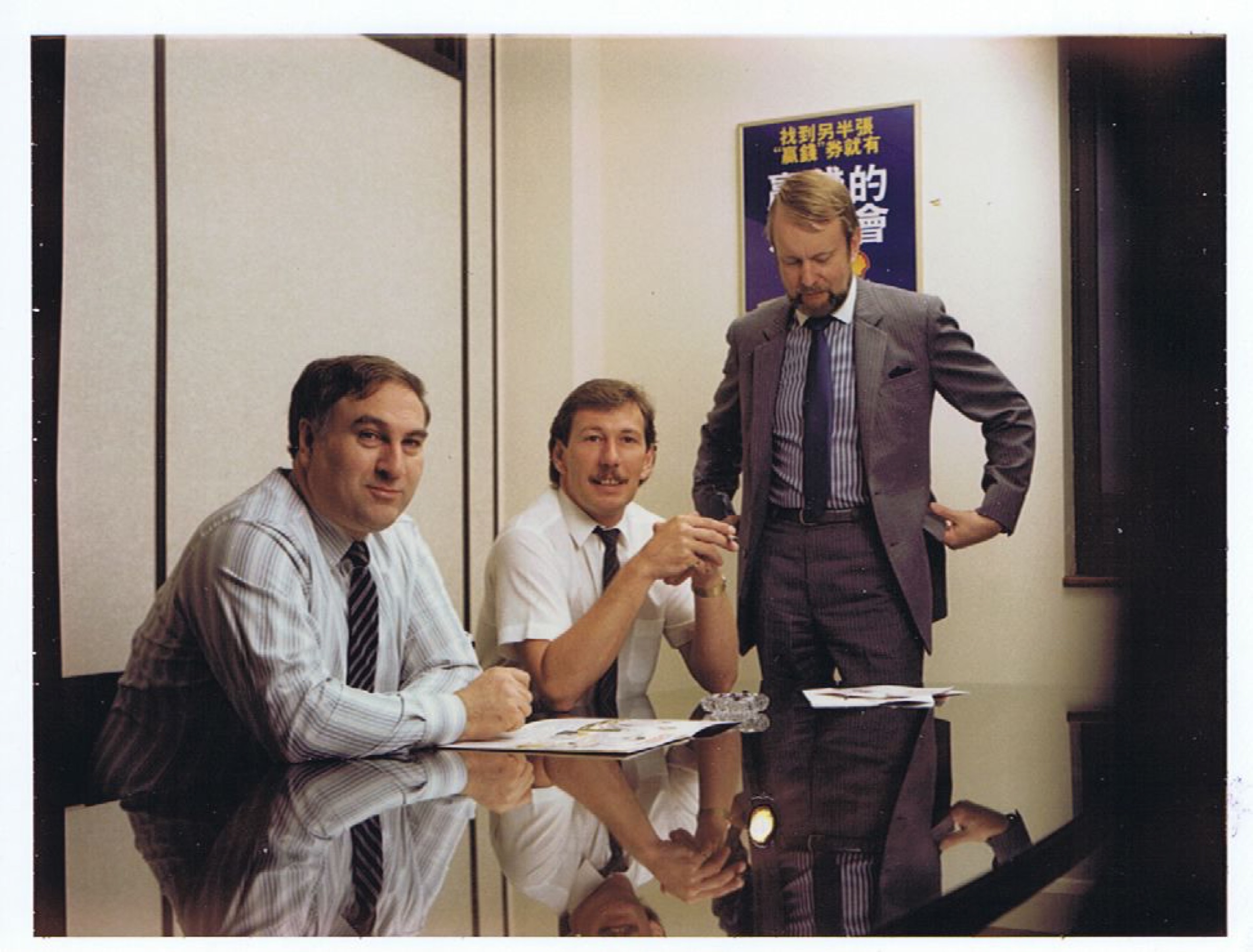
John Donovan, Roger Sotherton and John Chambers at Don Marketing's Chelmsford office, circa 1985.

A collage of game pieces created by Don Marketing for Shell and other blue-chip clients, circa 1985.

A collage of game pieces created by Don Marketing for Shell and other blue-chip clients, circa 1992.
Shell Promotions
Promotional material from Shell Make Merry, one of the Shell campaigns created during Don Marketing's successful years with the company, circa 1984.
A Shell promotional success story from the Don Marketing years, linked to a major Harrods tie-up, circa 1984-1985.
A 1991 Promotions & Incentives article on the Shell Star Trek promotion, reproduced as evidence of Don Marketing's public connection with the game.
A Shell Star Trek promotional game piece designed by John Donovan, circa 1991.
The Bot Wars
Generated by John Donovan using ChatGPT in 2026 as part of the bot-wars image set.
Generated by John Donovan using ChatGPT in 2026: an illustration reflecting the risk that artificial intelligence can produce confident but mistaken answers.
Generated by John Donovan using ChatGPT in 2026: an imagined argument among bots, reflecting the unreliability of machine certainty.
Generated by John Donovan using ChatGPT in 2026: an image invoking the Donovan archive as a large body of damaging material about Shell.
Memory And Aftermath
John Donovan in his back garden in 2020, photographed by Nick Gill, holding surviving posters from the 1984 Make Money promotion for Singapore.

Generated by John Donovan using ChatGPT in 2026: a portrait sketch of the author.

Alfred Donovan, John's father, in an image/sketch reproduced from a Wall Street Journal article. The Wall Street Journal source/footer should remain visible wherever this image is reproduced.
Afterword
I did not write this book because I wanted one more row with Shell.
If that had been my aim, I could have carried on as before: posting material, comparing AI answers, recirculating old documents, and keeping the whole business alive by other means. I wrote the book for a different reason. After so many years, I did not want this story left scattered across letters, legal papers, internal company documents, websites, newspaper cuttings, and memory. A story like this either gets set down properly or it gets distorted, simplified, or quietly tidied away. I wanted a record that was human, readable, and as honest as I could make it.
I should also say what sort of record it is. It is not a court judgment. It is not a legal pleading. Some parts rest on documents. Some remain disputed. Some are my own recollection, belief, or interpretation, and I have tried to say so where that matters. But there is nothing uncertain about the broad effect this affair had on my life. It took years that should have gone elsewhere. It took money, energy, peace of mind, and opportunities that do not come back. It altered family life. It turned what ought to have been a chapter into a condition. People sometimes imagine that if a man keeps going, he must enjoy the fight. The truth is less glamorous. A struggle of this length is wearying, repetitive, and often deeply sad.
That is one reason I wanted the book written. I did not want the human cost lost inside the paperwork. Big disputes become abstract very quickly. They acquire labels, files, legal formulas, and public myths. What disappears is the simple fact that somebody has had to live inside them for years. I wanted readers to see that side of it as well. I wanted them to understand not only what happened, but what it is like when something that should have been settled long ago keeps following you through life.
That brings me to the present. I do not want perpetual war with Shell. I am nearly eighty. I would rather spend what remains of my life in peace than in another cycle of grievance, rebuttal, and attrition. But peace is not the same as surrender, and closure is not something the stronger party can simply announce for its own convenience.
After all these years, a proper ending would have a recognisable shape. It would require serious engagement, proper acknowledgment, fair redress, and binding finality. Those are not favours. They are the conditions under which a long public record could be brought to rest by the person who built it.
That is not a plea. It is a standard. Short of that, the record remains the record, and the book remains necessary.
I therefore want this book to be read separately from any present settlement position. I wrote it because I believed the story had to be told and the record had to exist. It is not a coded ultimatum. It is certainly not a case of pay me or I publish. That is not my position and it is not my purpose. The book stands or falls as a truthful account of a life partly diverted by this dispute.
The truth is that I no longer want this fight to be the main business of my days. I am nearly eighty. What I would like now is simple enough: peace, comfort, ordinary enjoyment, and the chance to spend whatever time remains in a happier place than the one this dispute has so often forced me to occupy.
There is still a difference between a living campaign and a preserved record. A fair ending would allow me to stop living inside the conflict. It would not erase the past, and it would not require the record to pretend that nothing happened. It would simply mean that the unresolved part of the story had at last been faced, addressed, and resolved.
That opportunity will not exist forever. I have begun thinking about how to ensure that the archive does not simply vanish after me. If the record passes fully into other hands, it may no longer be a campaign conducted by the man who lived through it. It may become something colder, more permanent, and much harder to extinguish: a preserved public archive.
The choice is no longer whether the record exists. It does. The only remaining question is whether Shell ever chooses to meet it with the seriousness it deserves. Until then, this book stands as my account: not a plea, not a bargaining note, but a record of what happened, what it cost, and why it was not forgotten.